Showing posts with label Winter Interest. Show all posts

Monday, December 29, 2014

Revisit Winter Blogs of Interest

by Carol Kagan, Master Gardener

Here are some links to past blogs that may be of interest, especially the one about de-icers. We are fast approaching a day when we will have to deal with ice - either at home or work.

Also be sure to check out our upcoming workshops and classes. January programs are taking registrations now. Call 263-9226.  E-mail franklinext@psu.edu and be added to our monthly notification of upcoming programs and events.

Check out these previous BLOGS for interesting and useful information. Most have additional links with even more information.

Winter Weather and Deicers
Salt Tolerant Gardens
 
Poinsettia Season
Poor Poinsettias


Landscaping for Fours Seasons of Interest

Plants for Winter Interest- Many plants in Iris Masters' yard showoff in the winter landscape (Crape myrtle, magnolia, oregon grape, birch trees, nandina, cypress, Japanese Andromeda).

Japanese Andromeda

The following blogs are part of a continuing series highlighting plants with winter interest. These are plants chosen by our Master Gardeners to provide color or interesting shapes during the winter season.

Winter Interest Pt. 1- Partridge Berry
Winter Interest Pt. 2- Snowdrops
Winter Interest Pt. 3-Stinking Hellebore
Winter Interest Pt. 4-Rattlesnake Plant
Winter Interest Pt. 5-Lavender
Winter Interest Pt. 6-Witch Hazel
Winter Interest Pt. 7-Paperbark Maple
Winter Interest Pt. 8-Teaberry
Winter Interest Pt. 9-Harry Lauder Walking Stick
Winter Interest Pt. 10-Coral Embers Willow
Coral Embers Willow in the Winter Landscape
Winter Interest Pt. 11-Corkscrew Willow
Winter Interest Pt. 12-River Birch
Nandina
Ascot Rainbow’ Spurge - A Year-round Delight
Whimsical Winter Wonderland

Tuesday, March 11, 2014

Time for a Haircut

Last week I was sitting around shivering, wondering when, if ever, spring might show its face in south-central PA.  I got my answer today (March 8th) as the sun shone and the temps rose.  True to my calling (Master Gardener/Dirt-Digger/Plant Executioner Extraordinaire - I am sure there are others you can dream up, and they are probably all true), I set out for the backyard to decide what terror I could unleash.  After a short (and soggy) review of the winter damage (see my blogs, Winter Damage, part 1 and 2…), I decided that I could begin the trimming of the Coral Ember Willow.

Coral Ember Willow in a Winter Landscape

Some of you may recall my 2013 blog on this plant (Winter Interest, Part 10 - Coral Ember Willow, 01/22/13).  Real briefly, Salix alba ssp. vitellina 'Britzensis' is a fast-growing, vigorous, hardy, colorful large shrub.  Its inexpensive, gets large, gets woody, and wildlife likes it.  During the growing season, it is a good screen shrub, but is most interesting after the leaves fall off, with yellow, red and orange branches that glow in a snowy winter landscape.

Branch colors vary on the same shrub
It needs space.  My 11 year old model grew to over 15 feet this year.  My 3 year old's were over 6 feet.  It does need trimmed back every year before it leafs out if you have any interest in controlling its size.   That means cutting as much of the last year's growth (the colored branches) as possible.  The further back you cut, the better the color the following winter.

So yesterday I did my thing out there in the spring sunshine.  Evidence follows.

After the haircut (see branches on the ground)


Close-up of one of my younger pups
There is a lot of debris to get rid of.  Some get put in a bucket of water, so they can root and be started for the Master Gardener's plant sale (May 17, 2014; 9AM-1 PM at the Franklin County Extension Office grounds).  Others will be used for decorating and crafts, or making trellises for plants.  But I'm ready to see my willows start to leaf out again.

Sunday, February 23, 2014

Look for Winter Interest Opportunities

by Carol Kagan, Master Gardener
Still lots of snow but a good day to look around
Today was a great opportunity to get outside - warm (well-not so cold), clear and sunny. I took a walk around the house and yard to check the status of the trees and shrubs after the big snows and cold weather.

I'm following up on last fall's landscape design class. It was a good day to record what it looks like in winter, especially where I might need winter interest.

The line of arborvitae trees along the edge of the yard did not fare well last year but were rescued by wrapping them with twine to hold them together. This year we neglected to be proactive and they have suffered again. We anticipate only some branch loss. Next year we will have to follow a neighbor's strategy and tie them up in burlap.

Arborvitaes suffered damage in the snow & ice
Putting burlap around shrubs can prevent winter damage

Side yard - future shade garden


The side yard has been partially cleared for a shade garden next year thanks to Denise Lucas and Nancy Miller's inspiration at the Shade Gardening workshop. The yews at the far end revived after we kept shaking the ice and snow off. The back layer of the garden will need something evergreen that thrives in shade or an interesting winter shrub. There is a small azalea at the near end.


I'm thinking a Japanese Andromeda (Pieris japonica) might be good and a few dwarf boxwood that would be a good backdrop to other plants if kept trimmed.

Side yard - future Mediation Garden
The yard on the other side is earmarked as a Meditation Garden sparked by Alloway Creek's Sanctuary Garden (somewhere in the future). Taking a cue from Nancy Miller I want to make a doorway (hydrangeas?) near the front with the garden area near the wall having a few layers of plants. Electrical work this summer will add an exterior outlet for a future fountain.

I'm saving my pennies for a Frank Lloyd Wright Midway Garden Sprite statue.

To hide the air conditioner I hoping to put a trellis at a 90 degree angle and put a vine or two - maybe an evergreen like one of the varieties of clematis along with a summer bloomer.  With deciduous trees and southern exposure this side gets good winter sun.


My neighbor has a Harry Lauder Walking Stick tree sited perfectly for winter interest and our somewhat twisted cherry trees are also interesting.
Harry Lauder Walking Stick (L) & Cherry Trees (R)
So look for some clear days outside and do an inventory of where you might add some plants for winter interest. This will give you an excuse to look at all the catalogues that are coming in the mailboxes.

Right. like you need an excuse!

Tuesday, December 31, 2013

Winter 2013 in the Demonstration Gardens

By Carol Kagan, Master Gardener

Wind gusts to 30 mph
Stopping by the office today, the last day of the year, I wandered among the Master Gardener Demonstration gardens checking out the winter scene there. I had my camera with me so I snapped pictures. It was cold and windy and, without gloves so I could work the camera, my hands were numb.
So here’s the 365th day of 2013 scoop.

In the Pollinator Garden the water fountain has been winterized and covered and garden clean-up deferred until spring thaw. Leaf litter is the winter home of hummingbird moths. Mason and leaf-cutter bees use hollow twigs to nest.

Dried Hydrangea flowers still standing
Clumps of dried grasses or hollow canes of hydrangea and brambles are nesting sites if allowed to stand through the winter.

Also found in the pollinator garden were garlic chive (L) and sedum (R) seed heads. Not only pollinator friendly but winter interest, too.

The Xeriscape Garden was prepped for winter but several plants stood out showing examples of winter interest.
It looks like neatness counts in the Perennial Garden as all the beds were quite tidy and mulched.
Amsonia
 
Still showing a bit of autumn color and interesting shape is the amsonia.
 
 
For the Herb Garden’s first winter, plants were pruned back and mulched for winter using shredded mulch, leaves and corn husks.
The culinary bed rosemary was swaddled in burlap to help it overwinter while in the biblical bed the rosemary is mulched and tucked in under the wooden trellis.
Rosemary with burlap (L) & sheltered with mulch and trellis (R)
Thyme is still green and doing well along the front edge and the Fragrance bed still has the gray hues of lavender showing.
Thyme is still green

Fragrance bed with gray lavenders


Perhaps the Native Garden has the most variety of winter interest with so many different kinds of plants - ivory colored dried goldenrod plumes, blue viburnum berries, red holly berries and the many shades of browns on the pin oak holding tight to its dried leaves.


There are also lots of dried grasses and seed heads, providing not only winter interest but maybe home and buffet for overwintering birds and insects.

 Pink Hairwan Muhly Grass - fine dry wisps sway in the wind
Yarrow (Top left), Goldenrod (Right) and I don't know (Bottom left)

 
A bit of company on the walk - All photos by Carol Kagan
Check out these links for information on winter interest plants and more.
Winter Interest and Information
Overwintering Rosemary
Herb Garden: Final Touches

For more information on the Master Gardener demonstration gardens, search in the upper left corner: Herb Garden, Pollinator Garden, Xeriscaping, Perennial Garden, Native Garden, Victory Garden

Thursday, December 5, 2013

Winter - Interesting and Useful Information

The weather is changing and winter is bearing down on us.
Check out these previous BLOGS for interesting and useful information. Most have additional links with even more information.

Winter Weather and Deicers

Salt Tolerant Gardens

Overwintering Rosemary

Poinsettia Season

Poor Poinsettias


Landscaping for Fours Seasons of Interest

Plants for Winter Interest- Many plants in Iris Masters' yard showoff in the winter landscape (Crape myrtle, magnolia, oregon grape, birch trees, nandina, cypress, Japanese Andromeda).

Japanese Andromeda

The following blogs are part of a continuing series highlighting plants with winter interest. These are plants chosen by our Master Gardeners to provide color or interesting shapes during the winter season.

Winter Interest Pt. 1- Partridge Berry

Winter Interest Pt. 2- Snowdrops

Winter Interest Pt. 3-Stinking Hellebore

Winter Interest Pt. 4-Rattlesnake Plant

Winter Interest Pt. 5-Lavender

Winter Interest Pt. 6-Witch Hazel

Winter Interest Pt. 7-Paperbark Maple

Winter Interest Pt. 8-Teaberry

Winter Interest Pt. 9-Harry Lauder Walking Stick

Winter Interest Pt. 10-Coral Embers Willow
Coral Embers Willow in the Winter Landscape

Winter Interest Pt. 11-Corkscrew Willow

Winter Interest Pt. 12-River Birch

Nandina

Ascot Rainbow’ Spurge - A Year-round Delight

Whimsical Winter Wonderland

Tuesday, February 12, 2013

Plants with Winter Interest Part 12 - River Birch


River Birch in MG Karen Strimple's Landscape
About a year ago, Master Gardener Jill Hudock wrote about an elegant tree with beautiful exfoliating bark that added a textural component to her winter landscape – the Paperbark Maple, or Acer griseum. She also noted, however, that the tree can be a little pricey, as well as a bit finicky to grow.

River Birch in MG Karen Strimple's Landscape
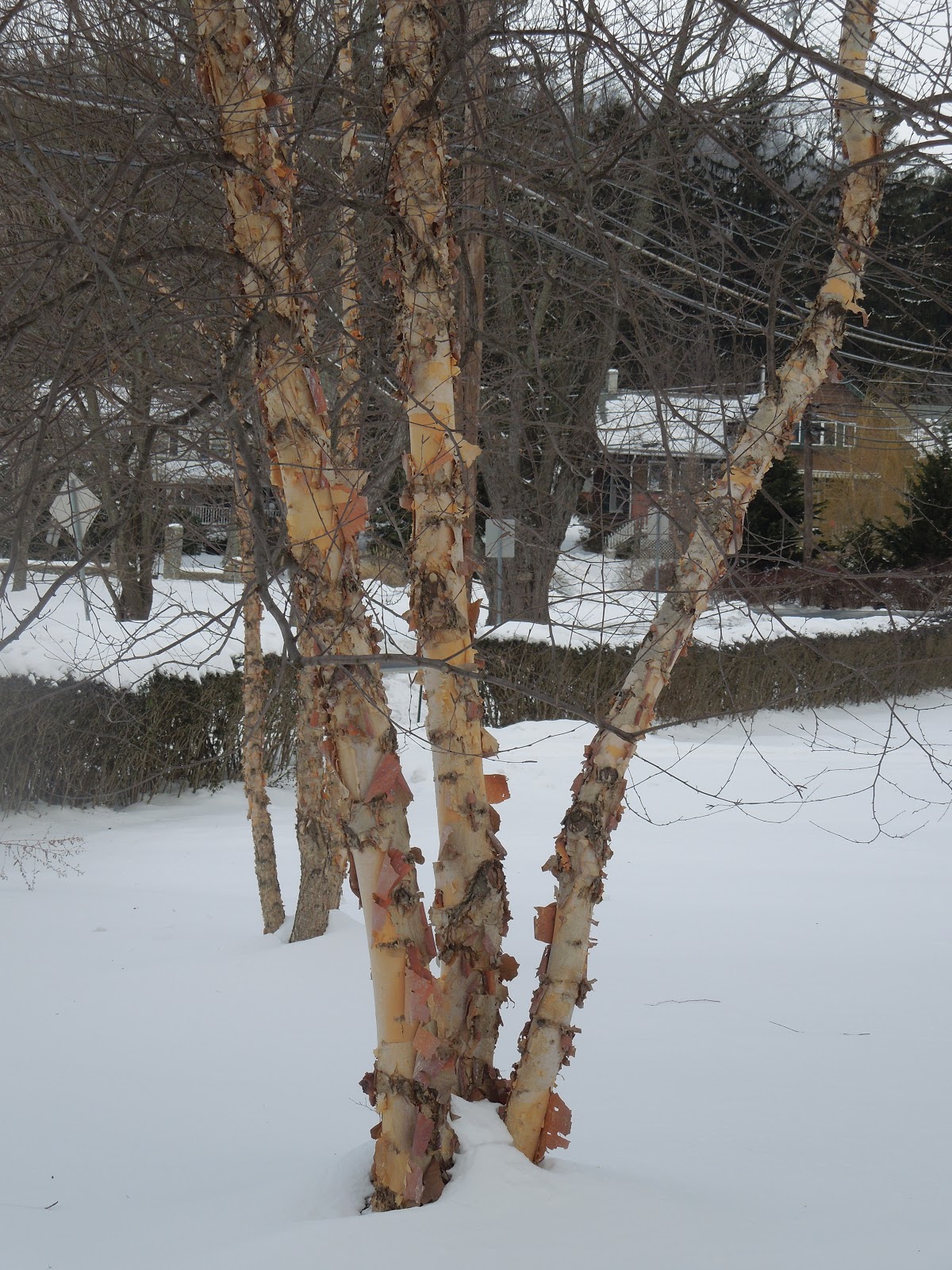
Here is another tree with exfoliating bark that also adds texture to the winter landscape, but is native to North America,  and is easy to grow, readily available, and comparatively inexpensive – River Birch, or Betula nigra. The genus name Betula is latin for “pitch”, which etymologists (word researchers) guess came from bitumen, a tarry substance that can be distilled from the bark of birch trees, and nigra translates as "black", referring to the mature bark color of the species.

River Birch in MG Karen Strimple's Landscape
River birch is a fast-growing, medium-sized, deciduous tree, hardy in zones 4-9, which occurs naturally on floodplains, or alluvial soils near rivers, and in marshes, or wetlands.

River Birch in MG Karen Strimple's Landscape
In the home landscape, it can be trained to form a single trunk or allowed to follow its natural tendency toward a multi-trunked tree. It is native to North America with a primary range in the southeastern quarter of the United States from eastern Texas and southeastern Iowa to Virginia and northern Florida. We’re at the northern end of its natural range here in Franklin County, although it is widely cultivated in home landscapes and public parks, and there are scattered natural populations found along rivers and streams as far north as southern Minnesota, central Wisconsin, and the middle New England States.

River Birch in MG Karen Strimple's Landscape
Height at maturity comes in at 40-60 feet. The tree is monoecious, meaning it forms separate male and female flowers on the same tree. Male flowers (catkins) are formed on twig tips in the fall and mature the following April or May. Female catkins appear with the leaves and open in early spring. The fruit matures in late spring or early summer, and is dispersed when it ripens. In their native habitat, River Birch seeds are a food source for a number of species of birds including ruffed grouse and wild turkey. Native Americans used the boiled sap as a sweetener similar to maple syrup, and the inner bark as a survival food.

River Birch in MG Karen Strimple's Landscape
The outstanding ornamental value of River Birch in the home landscape is the exfoliating, or peeling bark that provides the winter interest we’re looking for in this series. The bark color can vary from a dark gray-brown to pinkish-brown, or cinnamon colored, to a creamy, pinkish white, depending on the cultivar, peeling away in curly, papery sheets. Prince Maximilian of Austria, who later became the short-lived emperor of Mexico, called it the most beautiful of American trees when he toured here in the mid 19th century.


River Birch in MG Karen Strimple's Landscape
Master Gardener Karen Strimple has always been a fan of the tree, and when she and her husband moved to Blue Ridge Summit from the Washington DC area, their property offered the perfect spot – a site in the front yard with a perched water table that required landscape specimens that can tolerate wet feet, or soggy conditions that take some time to drain, especially in the early spring after snow melt. She’ll never forget the day the first tree was planted. It was September 11, 2001. Another tree was planted a few years later. Karen loves the “see throughness” of the tree in summer, with foliage that flutters appealingly in the breeze. A neighbor, with an older specimen, describes its canopy cover as the perfect place to serve afternoon tea.

River Birch in MG Karen Strimple's Landscape
The ability of River Birch to tolerate soggy conditions is augmented by its ability to also tolerate higher summer temperatures than the rest of the birches, as well as its high resistance to the bronze birch borer, which is a major pest of other birches.

River Birch in MG Karen Strimple's Landscape
Because of its native status, ability to tolerate wet, and warm conditions, and pest resistance, River Birch is recommended for use in riparian buffers and other restoration sites alongside streams and reclamation sites after strip mining for erosion control. These characteristics also make it an excellent choice to anchor a rain garden. A six year old specimen can be viewed in the Master Gardener Woodland Meadow and Native Habitat demonstration garden on the Franklin Farm campus.

Learn more about Plants with Winter Interest:

Winter Interest in MG Iris Master's Landscape and Other Penn National Gardens
Nandina - Heavenly Bamboo
Landscaping for Four Seasons of Interest
Plants With Winter Interest - Part 1 - Partridge Berry
Plants With Winter Interest - Part 2 - Snowdrops
Plants With Winter Interest - Part 3 - Stinking Hellebore
Plants With Winter Interest - Part 4 - Native Jewel Orchid
Plants With Winter Interest - Part 5 - Lavender
Plants With Winter Interest - Part 6 - Witchhazel
Plants With Winter Interest - Part 7 - Paperbark Maple
Plants With Winter Interest - Part 8 - Eastern Teaberry or Wintergreen
Plants With Winter Interest - Part 9 - Harry Lauder Walking Stick
Plants With Winter Interest - Part 10 - Coral Embers Willow
Plants With Winter Interest - Part 11 - Corkscrew Willow
Ascot Rainbow Spurge - a Year Round Delight