Showing posts with label winter damage. Show all posts

Sunday, April 13, 2014

Winter Damage - Blue Atlas Cedar


Blue Atlas Cedar - MG Debra Schaeffer's Landscape

Master Gardener Debra Schaeffer asked on Facebook whether or not her Blue Atlas Cedar (Cedrus atlantica 'Glauca') was dead or alive, posting this picture from her landscape in Shippensburg.


Apparently Debra is not alone in asking, since our friends at Snavely's Garden Center added that they've been getting a lot of calls about them lately as well. 

Sandy Feather, horticulture educator for Allegheny county wrote about the subject recently.  Here's Sandy.

Blue atlas cedar is rated as hardy to USDA Zone 6. Much of Allegheny County is listed as Zone 6a, with low winter temperatures ranging from minus-5 to minus-10 degrees, but the City of Pittsburgh is rated as Zone 6b, with winter lows from 0 to minus-5 degrees.

Whether they live or not depends in part on where you live. If you are in an urban area, where buildings and pavement hold more heat than suburban and rural areas, the foliage may just be burned and they will survive. If you live in the suburbs, especially the northern suburbs, they may not.

It also depends on how long they have been growing -- established plants have a better chance of surviving extremes than those that are newly planted. Likewise, plants that go into winter well hydrated and healthy will fare better than those that are stressed by drought or insect and disease problems.

In addition to brutally cold temperatures, strong winds play a role. While needled evergreens usually have a waxy coating on their needles that helps minimize moisture loss, blue atlas cedar needles are not as heavily waxed as many spruce and pines. Strong winds pull moisture through the stomata (pores) in the needles, but plants cannot take up additional moisture from frozen ground to make up for the loss. The result is the browning you see on the foliage of your blue atlas cedars. This type of damage is very evident on broadleaved evergreens such as English ivy, euonymus, pachysandra and rhododendron.

The bottom-line with your blue atlas cedars: Wait until they should start showing new growth as temperatures warm in spring. The brown needles will drop and new growth will start covering those bare branches if the foliage was just burned. If that does not happen, then they did not survive the polar vortex.

The revised USDA Hardiness Zone map and climate change have many gardeners pushing hardiness zones with plants that are marginally hardy for us, including crapemyrtle, camellia and photinia. That is fine, as long as losing these tender gems to a harsh winter doesn't break the bank. Again, some of these plants might die to the ground and come back from the roots, so do not be in hurry to dig them up. Give spring a chance to finally arrive and see if they show any signs of life, especially crapemyrtle -- it is very slow to come to life in spring.

Even plants that are generally hardy to Zone 5 may show dieback or other signs of damage when spring arrives. Spring-bloomers such as forsythia, big-leaf hydrangea and evergreen azaleas may only bloom close to the ground, where flower buds were protected by snow cover. Be patient and see what spring brings.

Sunday, March 9, 2014

Winter Damage, Part II (Voles)

Much to my dismay, I found that they are back.  The voles.  Not that I mind THEM so much.  Its what they do to my lawn.  To all my friends who love animals, I apologize for the following post.  I don't want these guys as pets, and I will do whatever I can to make my home an unwelcome abode for them and their families.

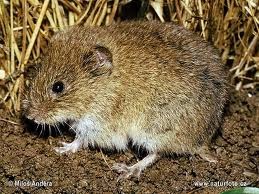
What is a vole?  There are 4 types of voles found in Pennsylvania, but the one that you will most likely encounter at your home is the meadow vole, a small ground-dwelling rodent, about 6", with short legs, short tails, and chubby bodies.

Meadow vole
Better view of short legs and tail


What is vole damage?  You know you have a vole problem if you find long surface runway systems with burrow openings in your lawn.  They have been under the snow, and the voles use the snow as cover as they go out and chomp on the grasses and plants they need to survive.  The voles are very tasty to a lot of predators; they are very active, but try to stay out of open space and grassy areas.  Voles are the only ones who make the above-ground tunnels in your lawn.  They have the snow as cover, and once the snow melts, they will normally disappear from your open lawn.  Your lawn should recover quickly in the spring.  

Vole runways appear as the snow melts in the spring
Voles are also trouble-makers for orchards and nurseries, where they often girdle tree bark.  Lots of other animals do this too, but vole damage on tree bark is usually non-uniform, with gnaw marks at various angles and irregular patches.

What I found when the snow melted...
They are often confused with moles (who have large front feet and digging claws, no external ears and a pointy snout), shrews (who have a long pointy snout, pointy front teeth and are smaller than voles), and mice (the biggest difference between mice and voles is the length of their tail; voles have shorter tails).  A vole has a rounded, not a pointy, snout, chisel-shaped teeth, and visible eyes and ears.

There are various methods of control:
1.  Habitat modification.  Keep grasses clipped, clean up leaf litter, keep a 2 foot vegetative-free zone around trees to discourage them from nesting near tree bases.
2.  Exclusion (fencing).  Make sure it goes 4-6 inches beneath the ground.
3.  Trapping.  Can be effective.  Make sure you release the little fellows over a half mile away.
4.  Predators.  Hawks, owls, crows, skunks, raccoons, snakes and cats all enjoy voles.
5.  Repellants and toxicants.  Not practical in your lawn.  Consult a licensed applicator or the Extension Office for questions about these in commercial sites.
6.  Fumigants and frightening are not effective with voles.
PS Voles have been known to carry a variety of potentially serious human pathogens (rabies, hantavirus, others) so even if you think they're cute, don't handle and try to make a pet of them…

I'm trying to do some trapping, but no luck so far.  My hope is that this article is right and as the snow melts, they are migrating to better cover (AKA anywhere other than my lawn) for the months to come.   


Winter Damage, Part I (Snow Mold)

There is danger out there lurking under the snow in your yard.  Its called gray snow mold.  If you have never heard of it, get familiar with it, because you will probably see it soon.  If you have dealt with it before, set your rake in a handy spot - you will need it soon.

Gray snow mold (Typhula blight) affects all cool season turf grass species where there is an extended period of snow cover.  We have experienced probably the longest period of snow cover here in the past ten years, so conditions are perfect for its appearance.

Gray snow mold grows by expansion of mycelium (the white fibers of fungus) under the snow.  It can't develop if there is not a period of snow cover on your turfgrass.  The longer your grass is in the fall, or the more leaf litter around your lawn, the more gray snow mold you can expect to find in the spring.

Gray snow mold in a lawn
The picture here shows some grey snow mold on a lawn as the snow melts.  And below is a close up in an area where the grass wasn't trimmed in the fall…looks like you have mold on your lawn.

Gray snow mold on longer grass
Control of gray snow mold involves three things:
1.  Mow your grass one last time late in the season fairly short (I usually do mine about the week of Thanksgiving).
2.  Clean up leaf litter and debris in the fall.
(Both these items make it harder for the gray snow mold to develop and flourish.  But in March, you've already missed both of those ideas…)
3.  As you see patches of gray snow mold as the snow melts, rake the patches with a leaf rake.  It breaks up the mold patches and increases air circulation and drying.  And that will usually kill the gray snow mold.  The patches should normally fill in as spring proceeds, if not you can overseed in the area of the damage.

Fungicides are rarely used on home lawns for gray snow mold.  Some extension sites recommend avoiding late fall fertilizing, as the additional nitrogen may encourage the growth of gray snow mold.

We're not done yet.  There is a second type, called pink snow mold.  It at least has some color to it…

Pink snow mold in lawn

Wouldn't you like that in your lawn for a bit of spring color?  Pink snow mold, Microdochium patch, is very similar to gray snow mold, but develops without snow cover.  Again, by keeping your lawn cut relatively short and cleaning up leaf litter and debris in the fall, you should be able to avoid meeting this guy in your lawn (the next time we have a winter without snow on the ground for an extended period!).


Thursday, December 5, 2013

Winter - Interesting and Useful Information

The weather is changing and winter is bearing down on us.
Check out these previous BLOGS for interesting and useful information. Most have additional links with even more information.

Winter Weather and Deicers

Salt Tolerant Gardens

Overwintering Rosemary

Poinsettia Season

Poor Poinsettias


Landscaping for Fours Seasons of Interest

Plants for Winter Interest- Many plants in Iris Masters' yard showoff in the winter landscape (Crape myrtle, magnolia, oregon grape, birch trees, nandina, cypress, Japanese Andromeda).

Japanese Andromeda

The following blogs are part of a continuing series highlighting plants with winter interest. These are plants chosen by our Master Gardeners to provide color or interesting shapes during the winter season.

Winter Interest Pt. 1- Partridge Berry

Winter Interest Pt. 2- Snowdrops

Winter Interest Pt. 3-Stinking Hellebore

Winter Interest Pt. 4-Rattlesnake Plant

Winter Interest Pt. 5-Lavender

Winter Interest Pt. 6-Witch Hazel

Winter Interest Pt. 7-Paperbark Maple

Winter Interest Pt. 8-Teaberry

Winter Interest Pt. 9-Harry Lauder Walking Stick

Winter Interest Pt. 10-Coral Embers Willow
Coral Embers Willow in the Winter Landscape

Winter Interest Pt. 11-Corkscrew Willow

Winter Interest Pt. 12-River Birch

Nandina

Ascot Rainbow’ Spurge - A Year-round Delight

Whimsical Winter Wonderland

Wednesday, January 16, 2013

Winter Weather and Deicers


Ice-laden trees provide an icy wonderland effect

Waking up this morning to a beautiful but icy wonderland, it was a reminder to find the bag of “salt” in preparation for the next winter event. It’s not really salt in the bag but calcium chloride.

Oops!
Icy surfaces can be hazardous to your wintertime health so removing snow and ice is a priority. You don’t want to be quoting the Muppets all day – “Watch out for the icy patch!”


Although safety first, gardeners also want to consider run-off damage to lawns and gardens. A special challenge is for plants near roadways, sidewalks and other hardscape areas so gardeners might consider a salt tolerant garden. The Penn State Extension Service in Montgomery County has a demonstration salt tolerant garden with more information on their Website.

Salt Tolerant Garden near Roadway
Chemical deicers come in various forms - pellets, flakes and liquids - but research shows that pellets from 1/16" to 3/16" work faster.  Regardless of the type, overuse causes problems. Only use as much as necessary.
Don't overuse deicers
Sodium chloride, also known as rock salt, melts ice down to 25 degrees and is inexpensive but it can burn plants as well as corrode metal and concrete. It is the most harmful, seriously injuring or killing plants near sidewalks or paved areas. Additionally, when it washed into storm drains, it is a nonpoint source of pollution to waterways impacting fish and marine life.

Rock Salt Damage to Grass
 

Other chemical choices include calcium chloride which melts ice down to -25 degrees. Overuse can harm plants. Potassium chloride is effective to 12 degrees and is a fertilizer; however, overuse can be deadly to plants. Urea, ammonia and carbon dioxide, works down to 15 degrees. Although used as a fertilizer, high concentrations can harm plants. Calcium magnesium acetate, a salt-free deicer using dolomitic limestone and acetic acid, is effective down to 5 degrees and is particularly useful in environmentally sensitive areas.

For areas where deicers can't be used, sand or kitty litter can provide traction but also can be a source of nonpoint pollution.
Learn more about deicers and plant damage:

Wednesday, March 10, 2010

Signs of Spring

I worked out in the front walkway garden yesterday cleaning around the birch tree so we could see the crocus that are blooming. My husband thinks the rabbits will be much happier now that dinner is on display.  I was really dismayed at the broken branches on some of the shrubs. The viburnum carlesii has a large branch that was partially split. I read in George Weigel's blog that sometimes if you tie the branch together with an old nylon, the branch may bond. I did this once with a foxtail spruce and it worked. I'm going to give it a try since I have nothing to lose but a branch. Some of the boxwoods had mangled branches, but after trimming them they don't look so bad. I won't mention all the vole trails...that's another day.

No matter how severe the winter damage, the crocus bloom gives me hope.