Showing posts with label Gardening for Wildlife. Show all posts

Tuesday, December 2, 2014

January Workshops for Families and Early-Start Gardeners

by Carol Kagan, Master Gardener

What are the Master Gardeners up to during the cold winter?

Workshops!!

Please note that workshops fill quickly. Call now to register. 717-263-9226

Sat., Jan. 10,  9-11 am: For the Birds (Family Friendly) - Make a birdfeeder and learn about attracting birds. $10 adult, $15 family

Sat., Jan 17, 9-11 am: Winter Sowing - One of our most popular workshops. Sign up early. Learn how to sow seeds outdoors in recyclable containers in winter and early spring. Make one to take home. $10

Sat., Jan. 31,  9-11 am: Fairy Gardens - Learn about scale, plants and maintenance in this informative program. $10

Tue., Feb. 3,  6:30-8:30 pm: Decoding Seed Catalogs - Learn how to read plant and seed listings to select the right plants for our area and your landscape. $10

Monday, January 20, 2014

Notable Native Herb: Redring Milkweed


By Carol Kagan, Master Gardener
Redring Milkweed (T.G. Barnes, USDA)
Selected by the Herb Society of America, Asclepias variegata [Ass-KLE-pee-us  var-ee-GAY-tuh] is the Notable Native Herb for 2014. This species of milkweed has white, waxy flowers with reddish rings around the middle resulting in its common name, Redring Milkweed.
Redring Milkweed native areas & endangered in CT, NY & PA

This perennial plant is native to the lower 48 states as well as Canada and is hardy in zones 6a-8b. It is on the endangered list in Connecticut, New York and Pennsylvania. It does best in moist to dry shaded roadsides, woodlands and open forest. While it likes moderate shade it tolerates full sun.
Redring Milkweed on edge of forest (J.S.Kos)
The plant grows to 3 ft. tall and has terminal clusters of white waxy flowers with a red ring between the sepals and the upper part of the flower. This species of milkweed has many of the same characteristics as other milkweeds. The plant has a long taproot that makes it very hardy and it produces lots of nectar.  The broken stems and leaves leak a milky liquid.
Crab spider on redring milkweed (J.S.Kos)
The flowers have a sweet odor. Bees, wasps, butterflies, flies, spiders and ants can be seen on its flowers. Although pollinator fans know milkweed as a host plant for monarch butterfly caterpillars, the milk of this species is not an important food source for them. The stands of this plant are sparse and often in shade which may contribute to the few monarchs seen on them.

Redring Milkweed Pods (G.S.Williamson)


This plant flowers from May to June and produces narrow, upright seed pods. It can be propagated from the seeds or plant division. Note that it is on the endangered list in Pennsylvania.

Redring Milkweed Close-up (D.D. Taylor, USDA)
Links for more information

USDA Plant Database: Redring Milkweed
Anybody seen my focus-JS Kos Blog: Redring or White Milkweed


Saturday, January 11, 2014

“For the Birds” Workshop Brings in A Flock

By Carol Kagan

Linda Secrist presents tips to attract birds

“Think of yourself as a bird,” said Master Gardener Linda Secrist, “and if you were flying over your yard, what would you see?”
The “For the Birds” Master Gardener workshop on January 11 hosted 23 participants interested in learning how to attract birds and getting tips on plant selection, bird watching and treats for birds.

“I have a great horned owl that sits on my roof and wakes me every morning,” said Carol Sirbaugh, Fayetteville. But there is a dearth of other birds despite her efforts with bird feeders so she was looking for more ways to attract birds.
Secrist described the four things that birds need to thrive: water, food, shelter and nesting areas. This time of year providing water for birds is a challenge and she presented several options to keep water from icing over in bird baths and ponds.
Bird nesting in a simple clay feeder
“Birds can eat up to three times their body weight every day,” Secrist noted. “So ‘eats like a bird’ really has a different meaning than we use every day.” Since different birds like different food, she listed the seeds and foods, such as suet and fruit, that various birds prefer.

Linda Secrist talks about different seeds and bird foods

Inspired by the book “Cooking for the Birds” by Adele Porter, Secrist displayed interesting food concoctions including belly jelly and pasta al fresco. Joyce Randolph, Hagerstown, MD, was particularly interested in the woodpecker waffles and intended to make some at home.
A variety of foods for birds
Kylie Deaton, Hagerstown, came with her mother and said, “I learned about different foods like the waffles and pasta.” As the 4th grade reporter for her class, she expects to do a report on the workshop for the next newspaper issue.

Many in the workshop raised their hands when asked who had not cleared every perennial in their yard in the fall. Secrist pointed out that this is a good strategy for attracting birds during the winter months.
The best flowers to attract birds are single-petaled varieties like this coneflower.
With some plants already in place, Penny Farrah, Greencastle, said she wanted “to know more about what plants” to add. She had already jotted down coneflowers, a new plant to add.

Selecting native plants and flowers that birds like are important for providing not only food but shelter and nesting sites. Hedgerows and larger shrubs offer cover for birds and trees are the typical nesting site for most birds.  

Carl Robillard, Shippensburg, has three acres he is landscaping. “I want to include bird friendly plants and shrubs so this workshop was interesting about that,” commented Robillard. A Master Gardener suggested the native elderberry shrub as a good choice to consider.
As for birdhouses, Secrist said, “Your bird house should be boring.” Plain, well-constructed shelters with access to clean them out are what birds seek, not the brightly painted and decorated houses.
John Myers (R) and Rebecca & David Irvin(L) at the workshop
In response to an inquiry if bluebirds in this area migrate over winter, John Myers, Marion, PA, mentioned that his “mother had three or four bluebird houses and the bluebirds were around during the winter.” Myers added the bluebirds had “a couple sets of babies every year.”

Both Rebecca Irvin and her dad, David, Chambersburg, already have quite a variety of bird visitors but wanted to find out how to attract others. Rebecca said she learned about a lot of different stuff that was bird food. 
Rebecca was suited up in her soccer gear and heading to an indoor game but she stayed after the workshop to talk about all the different birds they see both at home and when vacationing. She knows she won’t hear the beautiful song of the hermit thrushes in Maine at home in Chambersburg, but expects to see a bigger variety at home now.

Photo credit: Carol Kagan

Tuesday, February 12, 2013

Plants with Winter Interest Part 12 - River Birch


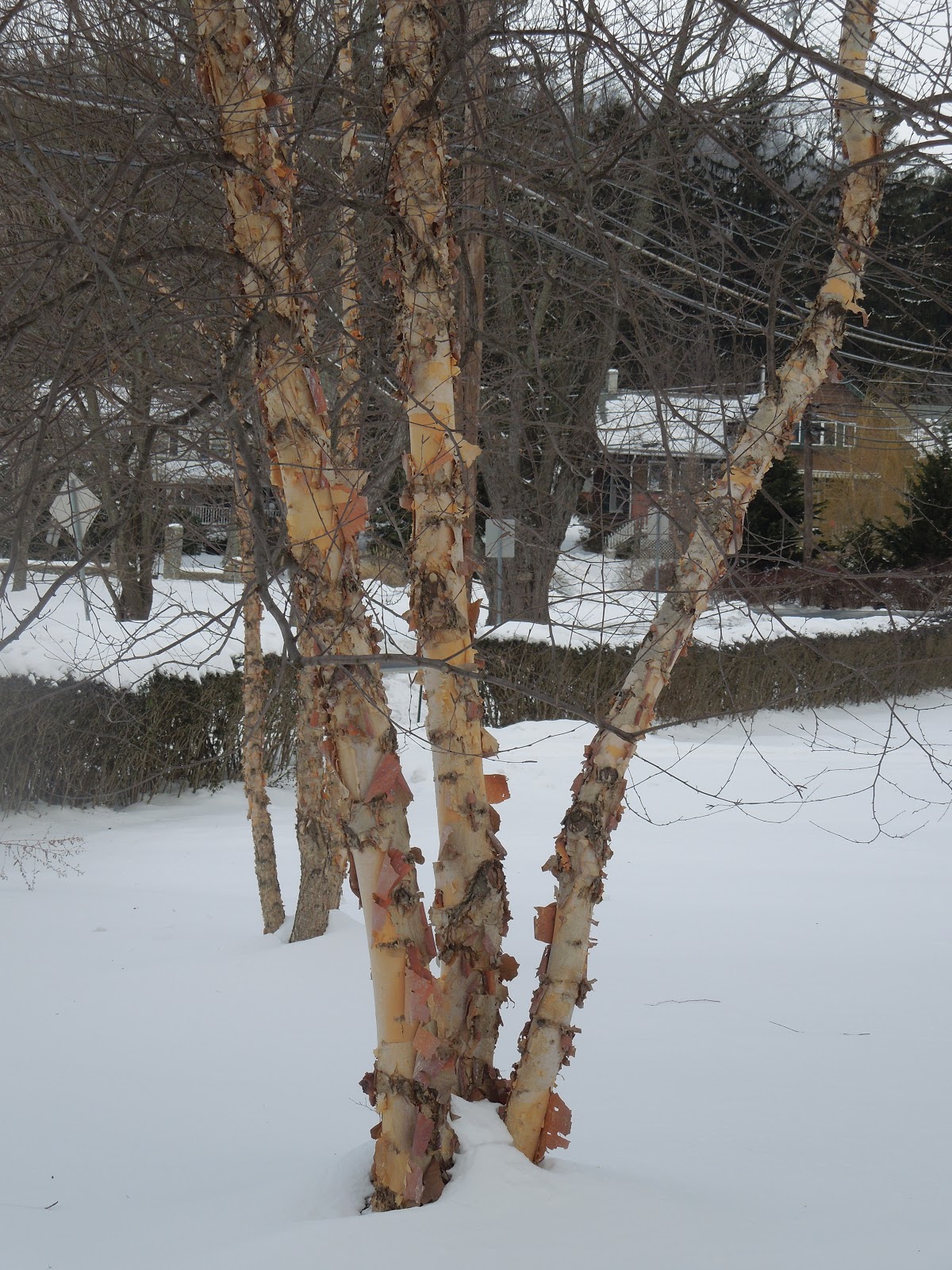
River Birch in MG Karen Strimple's Landscape
About a year ago, Master Gardener Jill Hudock wrote about an elegant tree with beautiful exfoliating bark that added a textural component to her winter landscape – the Paperbark Maple, or Acer griseum. She also noted, however, that the tree can be a little pricey, as well as a bit finicky to grow.

River Birch in MG Karen Strimple's Landscape
Here is another tree with exfoliating bark that also adds texture to the winter landscape, but is native to North America,  and is easy to grow, readily available, and comparatively inexpensive – River Birch, or Betula nigra. The genus name Betula is latin for “pitch”, which etymologists (word researchers) guess came from bitumen, a tarry substance that can be distilled from the bark of birch trees, and nigra translates as "black", referring to the mature bark color of the species.

River Birch in MG Karen Strimple's Landscape
River birch is a fast-growing, medium-sized, deciduous tree, hardy in zones 4-9, which occurs naturally on floodplains, or alluvial soils near rivers, and in marshes, or wetlands.

River Birch in MG Karen Strimple's Landscape
In the home landscape, it can be trained to form a single trunk or allowed to follow its natural tendency toward a multi-trunked tree. It is native to North America with a primary range in the southeastern quarter of the United States from eastern Texas and southeastern Iowa to Virginia and northern Florida. We’re at the northern end of its natural range here in Franklin County, although it is widely cultivated in home landscapes and public parks, and there are scattered natural populations found along rivers and streams as far north as southern Minnesota, central Wisconsin, and the middle New England States.

River Birch in MG Karen Strimple's Landscape
Height at maturity comes in at 40-60 feet. The tree is monoecious, meaning it forms separate male and female flowers on the same tree. Male flowers (catkins) are formed on twig tips in the fall and mature the following April or May. Female catkins appear with the leaves and open in early spring. The fruit matures in late spring or early summer, and is dispersed when it ripens. In their native habitat, River Birch seeds are a food source for a number of species of birds including ruffed grouse and wild turkey. Native Americans used the boiled sap as a sweetener similar to maple syrup, and the inner bark as a survival food.

River Birch in MG Karen Strimple's Landscape
The outstanding ornamental value of River Birch in the home landscape is the exfoliating, or peeling bark that provides the winter interest we’re looking for in this series. The bark color can vary from a dark gray-brown to pinkish-brown, or cinnamon colored, to a creamy, pinkish white, depending on the cultivar, peeling away in curly, papery sheets. Prince Maximilian of Austria, who later became the short-lived emperor of Mexico, called it the most beautiful of American trees when he toured here in the mid 19th century.


River Birch in MG Karen Strimple's Landscape
Master Gardener Karen Strimple has always been a fan of the tree, and when she and her husband moved to Blue Ridge Summit from the Washington DC area, their property offered the perfect spot – a site in the front yard with a perched water table that required landscape specimens that can tolerate wet feet, or soggy conditions that take some time to drain, especially in the early spring after snow melt. She’ll never forget the day the first tree was planted. It was September 11, 2001. Another tree was planted a few years later. Karen loves the “see throughness” of the tree in summer, with foliage that flutters appealingly in the breeze. A neighbor, with an older specimen, describes its canopy cover as the perfect place to serve afternoon tea.

River Birch in MG Karen Strimple's Landscape
The ability of River Birch to tolerate soggy conditions is augmented by its ability to also tolerate higher summer temperatures than the rest of the birches, as well as its high resistance to the bronze birch borer, which is a major pest of other birches.

River Birch in MG Karen Strimple's Landscape
Because of its native status, ability to tolerate wet, and warm conditions, and pest resistance, River Birch is recommended for use in riparian buffers and other restoration sites alongside streams and reclamation sites after strip mining for erosion control. These characteristics also make it an excellent choice to anchor a rain garden. A six year old specimen can be viewed in the Master Gardener Woodland Meadow and Native Habitat demonstration garden on the Franklin Farm campus.

Learn more about Plants with Winter Interest:

Winter Interest in MG Iris Master's Landscape and Other Penn National Gardens
Nandina - Heavenly Bamboo
Landscaping for Four Seasons of Interest
Plants With Winter Interest - Part 1 - Partridge Berry
Plants With Winter Interest - Part 2 - Snowdrops
Plants With Winter Interest - Part 3 - Stinking Hellebore
Plants With Winter Interest - Part 4 - Native Jewel Orchid
Plants With Winter Interest - Part 5 - Lavender
Plants With Winter Interest - Part 6 - Witchhazel
Plants With Winter Interest - Part 7 - Paperbark Maple
Plants With Winter Interest - Part 8 - Eastern Teaberry or Wintergreen
Plants With Winter Interest - Part 9 - Harry Lauder Walking Stick
Plants With Winter Interest - Part 10 - Coral Embers Willow
Plants With Winter Interest - Part 11 - Corkscrew Willow
Ascot Rainbow Spurge - a Year Round Delight

Wednesday, January 30, 2013

2013 Herb of the Year™ Elderberry


Tree/shrub
Perennial
Growth: 4-12 ft.
Culture: Sun to partial shade; moist area w/good drainage
Flowers: White, May blooms
Fruits: Dark purple/black berries early September
Hardy: Zones 3-9 (Franklin County is Zone 6)
Native - Wildlife

----------------------------------------------------------

Selected by the International Herb Association, Sambucus spp. [SAM-boo-cus], or Elderberry, is the Herb of the Year™ for 2013. This is a description of Sambucus nigra L. ssp. Canadensis – the American Black Elderberry. The common name "elder" is from the Anglo-Saxon "ellen," meaning fire-kindler, most likely referring to the dry, pithy stems.
This perennial shrub or tree is native to the lower 48 states as well as Canada and is hardy across all zones in North America.
The shrub grows 4-12 ft. with fragrant white flowers in spring and blue to black-purple berries in late summer. This is a good, mid-size plant and excellent as a hedgerow or in a property border. This plant is often used in riparian (stream or river bank or pond edges) restoration.

It tolerates poor soil, likes sun to partial sun and does well in moist areas but with good drainage. It is shallow rooted and gardeners should use care when weeding under it. Propagation is best through seed germination but grafting and layering are also used.
 
 
Elderberry’s wildlife habit value includes food for over 50 species of songbirds and upland game birds. It provides nesting cover for small birds and the flowers provide nectar for pollinators.
 
Squirrels, bears and other browsers eat the berries while deer, elk and moose will browse the stem and foliage. However, the USDA notes that new growth of American elder contains a glucoside that can be fatal to livestock.
 

Elderberry is used in over-the-counter medicines, primarily to boost the immune system and it is a significant source of both vitamins A and C. The berries are also used as dye and food colorants.


Elderberry is cultivated commercially for the fruit. The berries are used in cooking with the most popular uses being elderberry wine, juice and syrup along with pies and candy.
Berries are harvested in late August and early September when they are dark purple. The red berries of other species are toxic and should not be eaten. Full clusters of berries are harvested and removed from the stems. If not used immediately, they should be stored in a cool dry area.
The wood from the elder plant is hard and has been used for combs, spindles and wooden pegs. The hollow stems are used for flutes and arrow shafts while the pith makes good fire tinder.
Elderberry is an excellent native plant to add to your landscape. Examples can be seen in the Native Plant demonstration garden at the Franklin County Extension Service.

Learn more about Elderberry:

Univ. of Missouri Extension Service- From Folklore to Science: Cultivating Elderberry

Thursday, July 26, 2012

Wildlife Area - Before and After

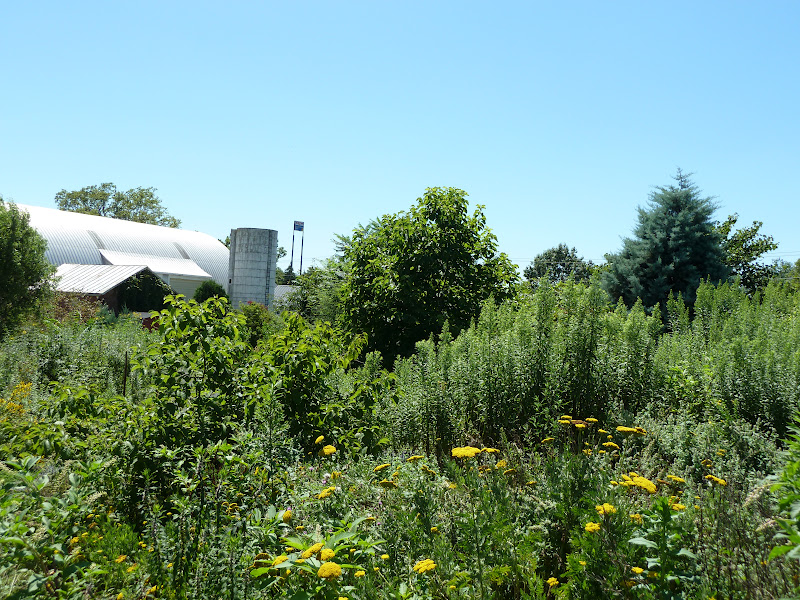
If you came to the monthly general meeting this past Tuesday, you got a glimpse of our Wildlife Area Demonstration Garden's transformation from a horse pasture to its current state.  Here's an attempt to use pictures from before juxtaposed with pictures taken Wednesday, July 25th, using the same, or similar angle.  Current pictures taken by Jenn Wetzel.

Before

After
Before
After
Before
After
Before

After
Before

After

Before

After

Before

After
Quite a difference.  Lots of work and TLC, especially from Wildlife Area Team Captain Jane Krumpe to get where we are.  Jane and Linda will be teaching a workshop on Saturday, August 25th - "Gardening for Wildlife" where participants will learn the principles of backyard habitat gardening.

Earlier pictures from the Woodland Meadow Native Habitat (Wildlife Area) Garden:  April 2012 and June 2012.

Oh - and check out how well we're doing attracting wildlife:

"A Place to Rear Their Young"