Today was a great opportunity to get outside - warm (well-not so cold), clear and sunny. I took a walk around the house and yard to check the status of the trees and shrubs after the big snows and cold weather.
I'm following up on last fall's landscape design class. It was a good day to record what it looks like in winter, especially where I might need winter interest.
The line of arborvitae trees along the edge of the yard did not fare well last year but were rescued by wrapping them with twine to hold them together. This year we neglected to be proactive and they have suffered again. We anticipate only some branch loss. Next year we will have to follow a neighbor's strategy and tie them up in burlap.
Arborvitaes suffered damage in the snow & ice
Putting burlap around shrubs can prevent winter damage
Side yard - future shade garden
The side yard has been partially cleared for a shade garden next year thanks to Denise Lucas and Nancy Miller's inspiration at the Shade Gardening workshop. The yews at the far end revived after we kept shaking the ice and snow off. The back layer of the garden will need something evergreen that thrives in shade or an interesting winter shrub. There is a small azalea at the near end.
I'm thinking a Japanese Andromeda (Pieris japonica) might be good and a few dwarf boxwood that would be a good backdrop to other plants if kept trimmed.
Side yard - future Mediation Garden
The yard on the other side is earmarked as a Meditation Garden sparked by Alloway Creek's Sanctuary Garden (somewhere in the future). Taking a cue from Nancy Miller I want to make a doorway (hydrangeas?) near the front with the garden area near the wall having a few layers of plants. Electrical work this summer will add an exterior outlet for a future fountain.
I'm saving my pennies for a Frank Lloyd Wright Midway Garden Sprite statue.
To hide the air conditioner I hoping to put a trellis at a 90 degree angle and put a vine or two - maybe an evergreen like one of the varieties of clematis along with a summer bloomer. With deciduous trees and southern exposure this side gets good winter sun.
My neighbor has a Harry Lauder Walking Stick tree sited perfectly for winter interest and our somewhat twisted cherry trees are also interesting.
Harry Lauder Walking Stick (L) & Cherry Trees (R)
So look for some clear days outside and do an inventory of where you might add some plants for winter interest. This will give you an excuse to look at all the catalogues that are coming in the mailboxes.
On July 6 it was hot by 9 a.m. so a woodland stroll through two cool, summer refuges was the perfect activity for the Master Gardeners of Penn State Extension, Franklin County Shade Gardening Workshop.
Master Gardeners Denise Lucas and Nancy Miller - the Shade (not shady!) Ladies - welcomed sixteen visitors to their gardens.
With a "challenging shade area under some locust trees," Becky Schubert, Greencastle, said she came to get some ideas.
The group gathers on Nancy's lawn
Denise and Nancy talk shade
They started out defining the characteristics of the different "shades of shade" - light, medium (part sun), and full. And be aware that shade changes as the sun moves across the sky.
Connie Strunk, Chambersburg, was "impressed with her [Nancy Miller's] shade data collection" of where and when the sun fell in her yard. She is planning to do this in her yard.
Textures are a basic shade element
Shade gardening is an opportunity to explore and play with different shades of green (and don't forget the occasional pop of color), texture and plant forms. At the right, a clematis vine with a pop of purple, slender bulb leaves and a lacy Japanese maple in the background play against the stones and ceramic fountain.
Coming up with a plan was on Laura Wentling's mind as she toured the gardens. As Nancy Miller's daughter she was noting specific plants she liked. "Once I come up with a plan," Wentling said, "she [Nancy] will come over. I will probably get some free plants, too."
A small "house" is a focal point in Nancy's plan
One interesting idea was to treat your outdoor space as you do your house - create small rooms or themed areas around the yard. Create a "door" with an attractive entrance that leads into the garden. An arbor or wooden bridge is a ready-made basic entry.
Side entry to Nancy's back garden area
The "floors" of your garden can be mulch, pine needles, grass, stones, or tiles while the "walls" could be fences, hedges, tall borders or shrubs. Decorate the walls with items that please you- chimes or hanging baskets of plants in the lower limbs of trees, sculptures, unusual planters and whimsical items such as a toad house or ceramic animal.
Tucked among the coneflowers
Overhead vines, arbors or pruned and shaped trees can provide "ceilings" but a peek of the sky as the sun moves is also interesting. Seating can be as formal as a table and chairs, a bench or even a tree stump.
Nancy created a great spot to sit and visit
A bench provides a place to sit and enjoy nature
Other ideas are to create areas such as a Japanese theme or a patriotic garden with red, white and blue. Garden areas that attract wildlife might include bird feeders and houses, water features and plants to lure butterflies and bees.
The wide variety of shapes and colors of hostas was a highlight in both gardens with both Nancy and Denise challenged to remember names such as Hanky-Panky, Guacamole, Patriot and Mouse Ears.
Many different varieties of hostas
The many varieties and colors of hydrangeas were also favorites
Master Gardener Barbara Petrucci liked the containers mixed in with the plants. "I think I want to get some containers and try that in my garden," she said.
A container adds a pop of color in a medium shade area
Around 11:30, after the garden tours, light refreshments were offered in the shade and everyone marveled at Nancy and Denise's beautiful gardens. Master Gardener Billy Morningstar said what was on many of our minds.
"I'm glad my shade area is small. I'm not as ambitious as these ladies."
True perennial spring ephemerals are plants that have evolved to complete their entire season in the relatively short time frame of early spring, before deciduous tree leaf out.
They emerge early, leaf out, bloom, set seeds, and their leaves die back completely, soon after the deciduous trees around them leaf out. As such, they really are not "shade loving" plants per se, but take advantage of the sun that's available during that short season.
You won't find them, for example, in forests dominated by evergreens, since the shade the evergreens cast is year-round. It explains why the "True Spring Ephemerals" I have in my shade garden don't do as well there as the ones that pop up in my woods.
There are spots however, where I think I can move them, in order to take advantage of this new knowledge and provide the environment that better matches their life cycle.
Conversely, some of the Native Spring Woodland species I had categorized as ephemerals, are true shade loving plants, with a much longer season. The blooming period of their flowers may be brief, but their leaves persist for a much longer time throughout the season, and will only die back (senesce) when exposed to too much direct sun or heat, well into the summer.
They may not do well in their natural setting, either, if their shade cover comes down via natural, or harvested tree toppling, creating an open sunlit clearing in the forest, until something grows up there to again provide the necessary shade.
The other major piece of knowledge gained about ephemerals is their evolved method of seed dispersal. According to what Annette dubbed the "MaCoy Hypothesis" (requiring further funding and study, any graduate students out there reading), their short life cycle dictates that they don't have the sun-generated carbohydrate reserves to create a true fruit, attracting browsers to eat it and disperse their seeds widely while foraging.
Instead, they create a sorta fruitlette (my made up word) called an eliaosome, a small piece of carbohydrate flesh attached to the seed, that instead attracts ants who find them, take them back to their nests, eat the eliaosome, and leave the seed to germinate and spread the plants' genes. The result, is that they do not spread very far from the original mother plant - a distance measured in yards, not miles, as in the case with bird or mammal dispersals.
This makes them more vulnerable to complete eradication in an area, without an easy means to recover, when their habitat is disturbed by tree harvesting, for example. The word scientists use for species with this method of seed dispersal is "myrmecochorous ", which we all got to practice pronouncing.
Here's a video on the subject, using Trilliums as an example:
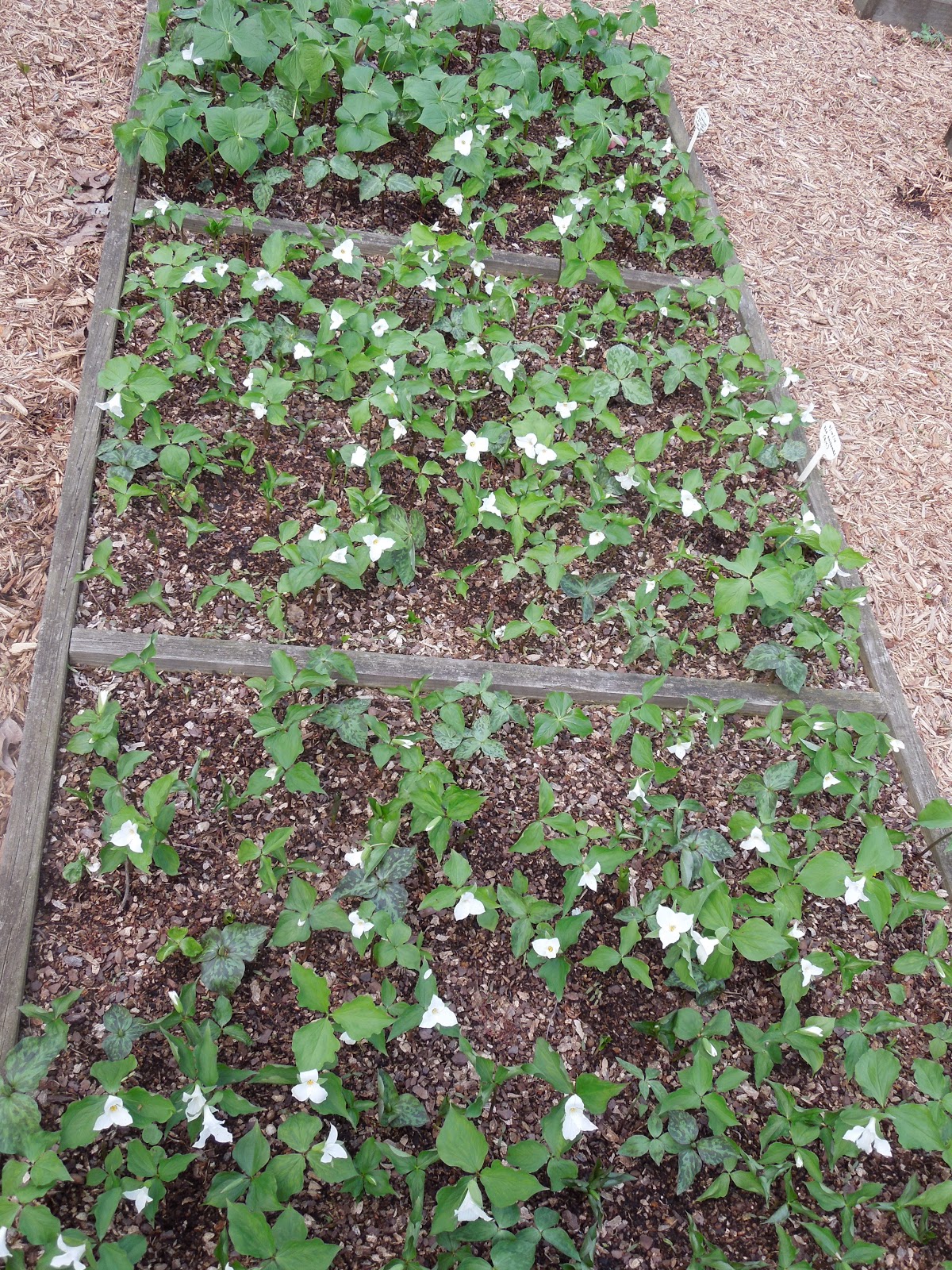
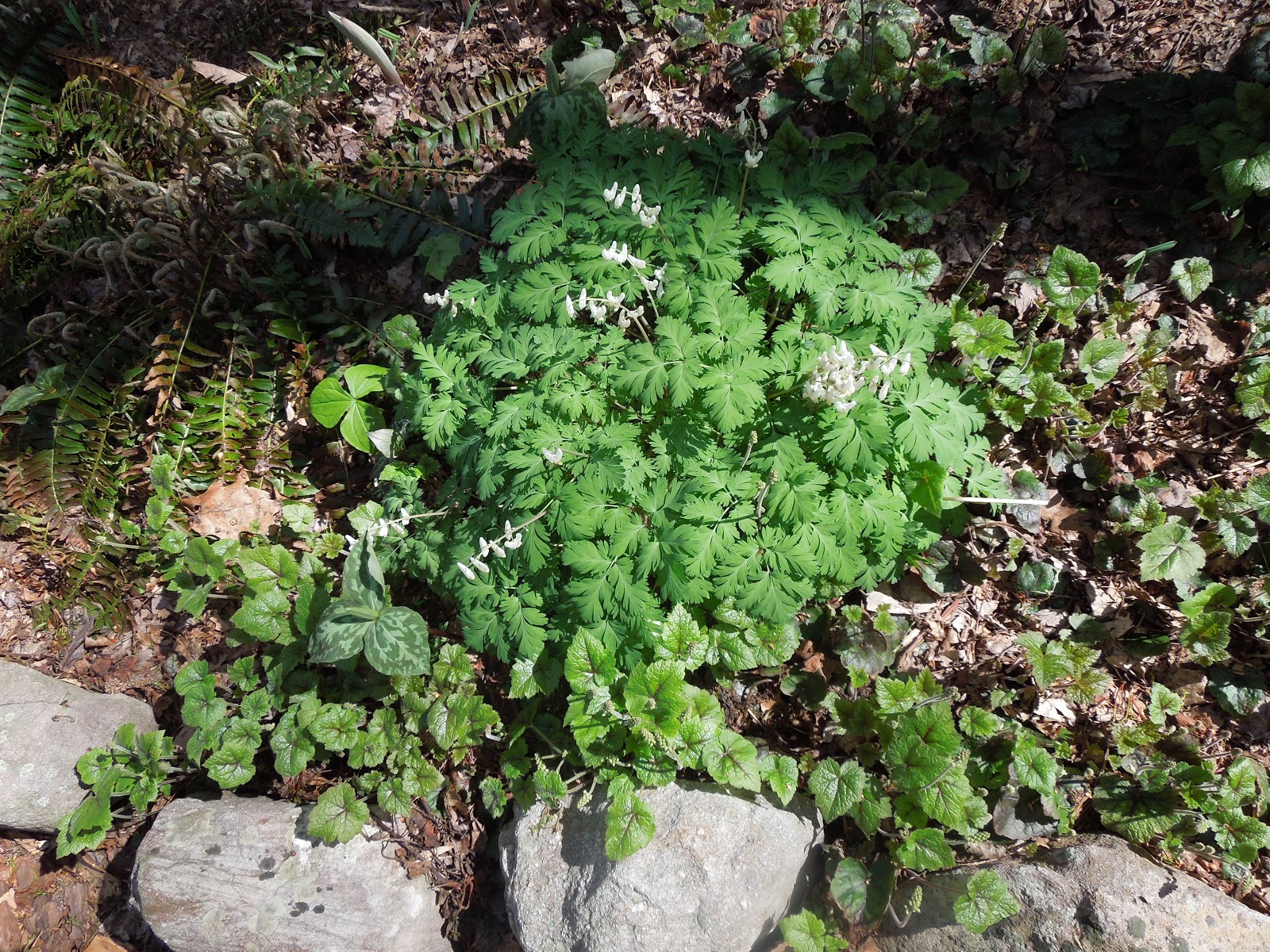
Annette chose 10 plants to talk about - all native woodland species - but clarified whether they were a shade-loving species, or a true spring ephemeral, and provided information about their particulars. Later, we took a walk through the gardens and propagation beds at Spring Haven, to talk about these and other species, and see them growing.
Hepatica nobilis - two kinds - round lobes (var. obtusa) and pointed lobes (var. acuta) - not a true ephemeral, since the foliage actually persists year-round, until the new foliage emerges in spring.
Eastern Red Columbine Aquilegia canadensis- not an ephemeral, and I also learned that they evolved to be pollinated by hummingbirds.
Skunk Cabbage Symplocarpus foetidus - Not a true ephemeral since the foliage persists until summer. (not pictured) more here.
Mayapple - Podophyllum peltatum- Not a true ephemeral, with an edible berry, but only when absolutely ripe. Poisonous otherwise. The foliage persists until the fruit ripens; it may senesce earlier if the summer is hot and dry. (not pictured)
Fringed Polygala, or Bird on the Wing - Polygala paucifolia - not a true ephemeral, and a one I had not heard of before (not pictured.) - foliage persists.
Fred Peabody
Here are some pictures of other folks who were there.
Fred Peabody of the Cumberland Valley Woodland Owners kicked off the program.
MG's Judy Scriptunas, Linda Secrist, and Jane Krumpe
Franklin County Master Gardeners, besides myself, who attended included Judy Scriptunas, Linda Secrist, and Jane Krumpe.
MG Juanita Kauffman and Husband Kenny
Penn State Extension Environmental Educator
George Hurd
MG Juanita Kauffman and her husband Kenny were there, as well as MG's Georgia Townsend, and Steve Gray (not pictured.)
The program was organized by Penn State Extension Environmental Educator, George Hurd.
Variegated Trillium?
This final picture came from the Facebook feed of Barry Glick, of Sunshine Farms and Gardens earlier this week. While absolutely stunning, it turns out that these Trilliums are infected with mycoplasma bacteria, which will eventually cause the plant to no longer flower, so they must be quarantined from other trilliums to prevent the spread of the disease.
Previous blog posts about my then understanding of Spring Ephemerals can be found here and here.
Update: Wednesday, May 1, 2013. Shoulda taken better notes. I had Annette review, and she caught some errors - all in the area of whether or not the plant qualifies as a true ephemeral. Corrections made. Won't tell you what they are to avoid further embarrassment.
Variegated Solomon's Seal emerging in MG Cindy Stead's Garden
Picture taken April 23, 2013
Back in February when I presented the 2013 Perennial of the Year, Variegated Solomon's Seal, I mentioned that Master Gardener Cindy Stead planned to document how they look througout the season.
Here are Cindy's first set of pictures showing them popping up in her shade garden.
Variegated Solomon's Seal, and Brunnera Macrophylla 'Jack Frost'
in MG Cindy Stead's Shade Garden
Here's another angle, that coincidentally shows off the 2012 Perennial of the Year, Brunnera macrophllya 'Jack Frost.'
We hope to keep you up to date on how they look throughout the growing season. Hopefully, we'll have donations from Master Gardeners at our Plant Sale on May 18th.
Click on the links for more detail about these plants for the shade garden.
Last season, we at Penn State Extension started getting calls about Impatiens losing their leaves and collapsing long before frost. The best calls were requests for bunny rabbit control as gardeners thought that rabbits had eaten all of their Impatiens’ leaves.
It turns out that we have a new disease, Impatiens Downy mildew, that specifically hits what most of us know as the “Common Garden Impatiens”, Impatiens walleriana. (Busy Lizzy) This disease does not infect other plants as of this time. There are other species of Downy mildew that infect most every plant if the pathogen is present and the conditions are right. However, it is very important to note that this disease does not infect New Guinea or Sunpatiens or any other flowers or herbs.
Downy Mildew on Impatiens
This disease was first reported in the United States in 1942. Since then, there have been sporadic outbreaks, but things started getting serious in 2004. Then widespread regional outbreaks were reported in 2011. The map showing where it was found in 2012 does not leave much of the U.S. disease-free.
Pennsylvania, like many states is a hotspot for this disease. If you had infected plants in your flower beds last year, then it is extremely likely that things will get worse this year. This pathogen overwinters quite well and can persist for many years.
How do you know if your Impatiens had it last year?
Yellowish or pale-green foliage
Downward curling of the leaves
Distorted leaves
White to light-gray fuzz on the undersides of the leaves. There are excellent images on the web if you search for “Impatiens Downy Mildew.”
Emerging, new leaves that are smaller than normal and discolored.
Flower buds that either fail to form or abort before opening.
Stunted plants
If you have relied on Impatiens for color in your shadier areas in the past, things are going to change at least until plant breeders come up with resistant varieties. For now, your best options are to use other plants that still perform well in the shade, and if you are fortunate enough to have avoided the disease so far, cull infected plants quickly if you see symptoms. Also, healthy-appearing plants adjacent to the diseased plants should be culled. Do not compost these plants, dispose of them.
Landscapers and those holding Pesticide Applicators Licenses have an additional option with an array of fungicides which if applied properly (timing and rate are very important) can control this disease. Home gardeners have a single active ingredient, phosphonic acid, marketed as Agri Fos, from Monterey Products and Exel LG from Organic Laboratories that should provide good control if used according to their labels.
The best option for many of us is to use alternative plants that perform well in the shade. Here are some to consider:
Wax begonias: These are a mainstay in the shade for many gardeners as they are compact, have good leaf color and texture and are available in market packs for larger plantings.
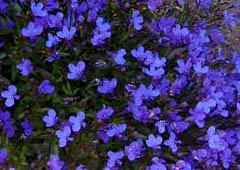
Lobelia erinus - Picture Courtesy of Cornell University
Lobelia: While they will perform best in the sun, they will tolerate partial shade.
Impatiens hybrid 'SunPatiens Compact Electric Orange'
SunPatiens: the plant-growing industry is currently looking at these as the go-to replacement as they are resistant to this disease even under heavy pressure and there are both upright and spreading types.
Coleus: look for those that are labeled for shade.
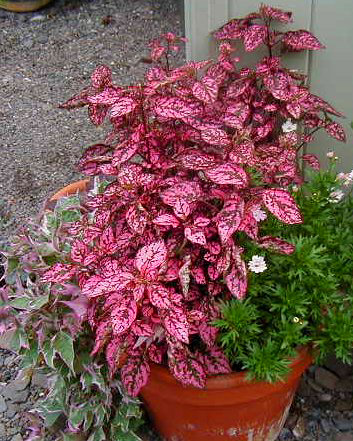
Picture Courtesy of Cornell University
Polka Dot Plant: Interesting spotted foliage plant now in many hybrid forms. It is shade tolerant, but not truly dark areas.
Alternanthera 'Purple Knight' (Joseph's Coat)
Joseph’s Coat: Another interesting foliage plant that does well in partial, but not heavy shade.
Our shady areas will probably look a bit different for the next several years, but there are some good options to Impatiens. Go to the SunPatiens’ website for advice on spacing, learn what this disease looks like and plan for another great gardening season.
Update: April 9, 2013. Steve's counterpart for Buck's County, Educator Scott Guiser has a post on the subject which you can read here. He also links to the Michigan State Q&A and another alternatives list from Ball Seed Company.
Update: April 19, 2013. Washington Post horticulture writer Adrian Higgins covers the topic here.


.jpg)