Thursday, January 10, 2013

2013 Notable Native Herb: Wild Beebalm

Wild Beebalm (Monarda fistulosa)
Flower/herb
Perennial
Height: 2-4 ft.
Culture: Sun, tolerates partial shade; good drainage
Flowers: Lavendar or pink in
Leaves: Herbal uses such as tea
Fruits: None
Hardy: Zones 3-9 (Franklin County is Zone 6)
Native - deer resistant - attracts pollinators


------------------------------------------------------------
Selected by the Herb Society of America, Monarda fistulosa [Mo-NAR-da  fist-yoo-LOW-suh], or Wild Bergamot, is the Notable Native Herb for 2013.

This perennial plant is native to the lower 48 states as well as Canada and is hardy in zones 3-9, although it is a self-seeding annual in the higher zones.


The plant grows 2-4 ft. with lavender or pink flowers atop the stems. Excellent in the middle of a perennial border, its lower green foliage provides attractive background for lower flowers in front. A member of the mint family, it can be aggressive so keep this in mind when picking a site.


It tolerates poor soil, likes sun to partial sun and good drainage plus it’s deer-resistant.  Propagate it through diving clumps in spring or fall, doing root stem cuttings or saving and germinating the seed.


This plant attracts pollinators such as bees, butterflies and hummingbirds who are drawn to the tubular flower petals. The cut flowers are long lasting in arrangements and the dried leaves and petals are used crafting wreaths, making potpourris and tussie-mussie nosegays.


Unlike the Monarda didyma, or Oswego Tea, plant with its citrus aroma and taste, M. fistulosa tastes like thyme and can be used as a thyme substitute. As a tea, or added to tea, expect a tangy flavor.

Consider adding this Notable Native to your yard or garden this year.


Tuesday, January 8, 2013

Penn State Extension and Franklin County Conservation District Joint Annual Board Meeting - January 25, 2013

The 3rd annual joint Meeting and Banquet of the boards of Penn State Extension and the Franklin County Conservation District will take place Friday, January 25th at Solomon's Lutheran Church, 4856 Wayne Road, Chambersburg.  Tickets are $12.50 for adults, $6.00 for children aged 5-11 (under 5 free) and are available at the Extension Office (263-9226), or the Conservation District Office (264-5499).

The program will include:  
  • 4-H Centennial: Generations making the Best Better for 4-H and Agriculture in Franklin County. Join the fun as four generations of 4-H members Siah Burkholder, Lucy Crider, Dr. Daniel Oliver, and Paul Lehman share a brief story on how 4-H impacted who they are today.
  • Conservation Farmer of the Year Award
Agenda:
  • 6:15 p.m....Fellowship & Displays
  • 7:00 p.m....Dinner
Menu:
  • Oven Baked Chicken
  • Ham Loaf
  • Scalloped Potatoes 
  • Green Beans
  • Pepper Slaw
  • Pie
History of 4-H

In 1907 or 1908, the first emblem used nationally was designed by O. H. Benson as a three-leaf clover. It stood for head, heart, and hands. In 1911, Benson suggested that the fourth H should be hustle, and the 4-H Clover design was adopted.


Later O. B. Martin suggested that health replace hustle. The 4-H emblem has stood for head, heart, hands, and health ever since.

In 1912, O. H. Benson established federal-state-county programs through cooperative agreements, which tied the three entities of Extension work together. Twenty-eight such cooperative agreements between the Office of Farmer Cooperative Demonstration Work and the land-grant colleges promoted youth club work.

You can read an abbreviated history of 4-H in Pennsylvania here, or download a 14 page detailed history here.

Friday, January 4, 2013

Flight of the Butterflies


New IMAX documentary "Flight of the Butterflies" tracing the efforts of Fred Urquhart and a team of volunteer "Citizen Scientists" to track and discover the winter congregations of migrating monarch butterflies.

From the Washington Post review:
It took decades of tagging and research to uncover the mysterious sanctuary, and Urquhart’s hard work is the filmgoer’s gain, enabling director Mike Slee to capture millions of butterflies in one place. Their constantly beating wings sound like raindrops on a forest floor, and when they converge side by side on branches, trees appear to be composed of orange and black butterfly bark. It’s an arresting visual that looks like something out of a Tim Burton film.

Here's the Smithsonian Website:
The monarch butterfly is a true marvel of nature. Weighing less than a penny, it makes one of the longest migrations on Earth across a continent to a place it has never known. Follow the monarchs' perilous journey and experience millions of them in the remote mountain peaks of Mexico, with breathtaking cinematography from an award winning team including Oscar® winner Peter Parks. Be captivated by the true and compelling story of an intrepid scientist's 40-year search to find their secret hideaway. Unravel the mysteries and experience the Flight of the Butterflies.

Nearest locations to see the film which opened this week in DC:   
Check the links for opening dates and showtimes in Harrisburg and Baltimore.

Earlier blog post from Kathy Engle:  Monarch Monday
All butterfly posts, including Kathy's wonderful Gardens with Wings series.

Wednesday, January 2, 2013

Gardening in Miniature

“Look Closely, the Beautiful May Be Small”  Immanuel Kant

Fairy Garden Booth at the Ass'n for Horticulture Professionals
Trade Show in August. Picture courtesy of Holly Scoggins
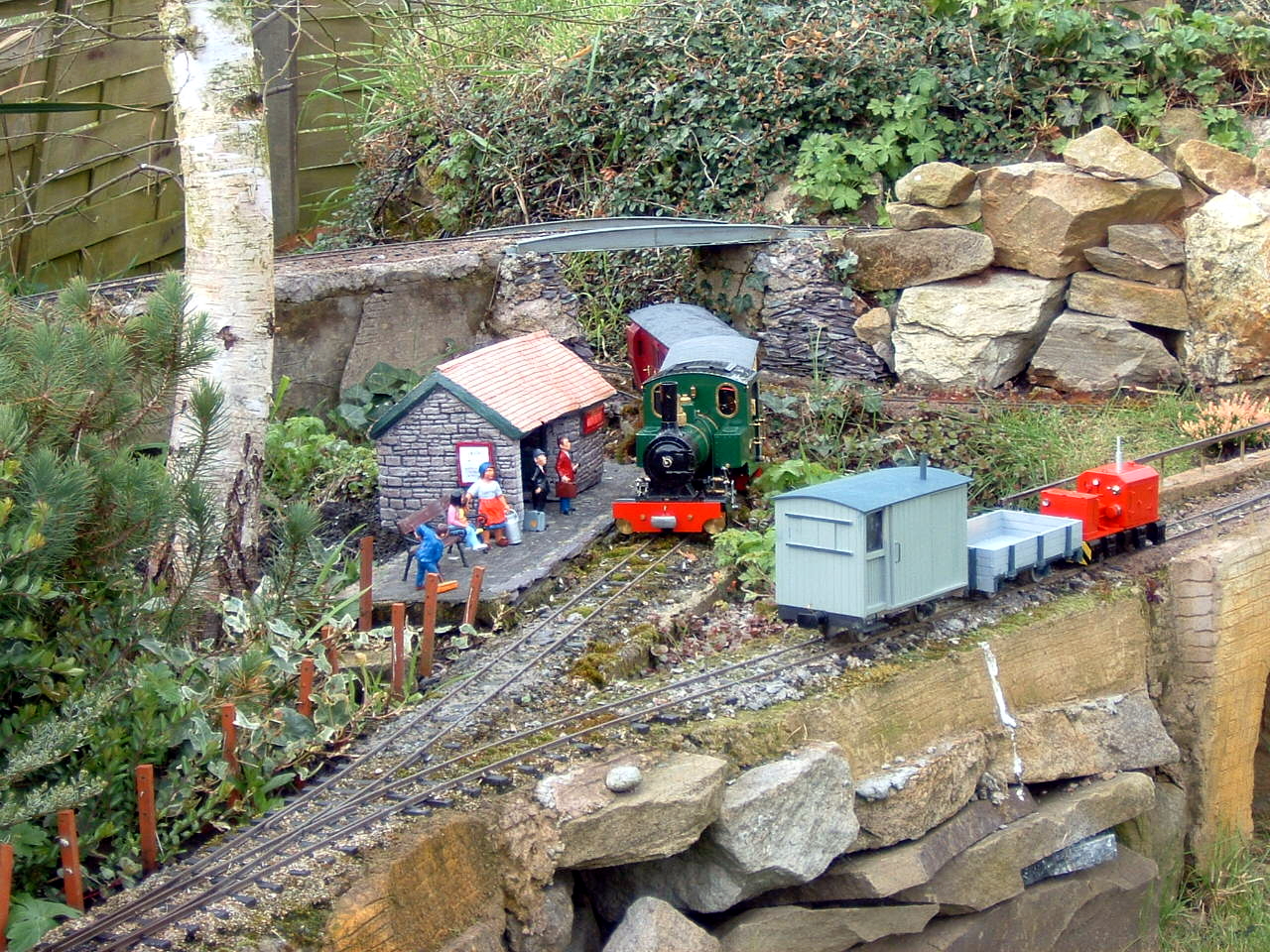
Two of the fasting growing hobbies in the horticulture world are Fairy Gardens and Railway Gardens. Consumer horticulture writer George Weigel recently noted the phenomenon in his "Trends for 2013" video, which you can view here. Garden Professor Bert Cregg of Michigan State University has also commented on the trend, and recommends this article from Digger Magazine on Railway Gardens.

Scene on a typical 32 mm gauge UK garden railway
Picture Courtesy of Wikpedia Commons
Fellow Garden Professor Holly Scoggins of Virginia Tech attended a trade show in August of this year, and noticed the proliferation of Fairy Garden plants and paraphernalia.  The eXtension Master Gardener blog has a recent post up about some cool conifers that work well in these environments.


Luckily for us, Franklin County Master Gardeners Juanita Kauffman (Fairy Gardens) and Bob Hyatt (Railway Gardens) have been enthusiasts for the hobbies for several years now, and have put together a workshop to share their knowledge with the public. Come to the Saturday, January 12th workshop from 9:00 - 11:00 a.m. to learn proper selection, care and maintenance of dwarf, compact, slow and low-growing, or tiny-leaved plants best suited for miniaturized landscapes, as well as general information about these fast growing hobbies.  The fee is $10.00. Contact the Extension Office at 263-9226 to register.

Pinus banksiana 'Uncle Fogy' Taltree Arboretum (Indiana)
Photo credit: Foy Spicer
Locally, Appalachian Nurseries, a wholesaler of landscape trees and shrubs, also has a retail business specializing in dwarf, or small leafed, slow growing plants for use in these miniaturized gardens and landscapes.

And the Mainline Hobby shop in Blue Ridge Summit caters to the model railroading marketplace.

Update:  Click to see pictures of Bob's Railway Garden.

Thursday, December 27, 2012

Plants With Winter Interest - Part 8 - Eastern Teaberry

Gaultheria procumbens
Folks of a certain age will probably remember the Teaberry Shuffle, a simple dance featured in a series of commercials of the 1960's promoting Clarke's Teaberry chewing gum. But did you know that the source of that familiar, Wintergreen flavor, is the native groundcover, Gaultheria procumbens, or Eastern Teaberry, and is a welcome addition to any shade, or rock garden to add winter interest.


Gaultheria procumbens
The genus was named for Dr. Gaultier, a Canadian naturalist and physician of the middle 1700's. Procumbrens comes from from the Latin verb procumbere to fall forwards, referring to its prostrate, or creeping along the ground form. According to a Rutgers University fact sheet, the Massachusetts explorer, Jonathan Carver wrote about it in his Travels Through the Interior Parts of North America in the Years 1766, 1767, and 1768, first published in 1778, describing it “in winter it is full of red berries about the size of a sloe [small fruit of the blackthorn], which are smooth and round; these are preserved during the severe season by the snow, and are at that time in the highest perfection. The Indians eat these berries, esteeming them very balsamic and invigorating to the stomach”.

Gaultheria procumbens
Eastern Teaberry is a spreading, evergreen, shrub which only grows 4 to 8 inches tall. It spreads primarily through undergound stems (rhizomes), sending up two to six inch branches each bearing 1-2 inch oval, shiny, dark green leaves which turn reddish in the cold weather. Small, bell-shaped, white to pink flowers bloom in mid to late summer and mature to bright red fruit in late autumn that often persists throughout the winter and into the following spring. It grows well in zones 3-7. It likes light to moderate shade; prefers acidic, evenly moist organically enriched soil but also does well in sandy soil.


Gaultheria procumbens
As a medicinal plant, it has been used historically as an analgesic, diuretic, stimulant, astringent and tonic. It was one of the ingredients in William Swaim's 1811 formula for Swaim’s Panacea. In 1831, the American Journal of Pharmacy reported that “the wonderful success of Mr. Swaim’s Panacea has brought this oil into great vogue”. Not quite snake oil, but close. The concentrated essential oil, Methyl salicylate, originally distilled from the plant, but now more likely created synthetically, is registered for use by the Envrironmental Protection Agency (EPA) as either an animal repellent (e.g., dogs and cats) for use on ornamental plants in residential garden plots, or as an insect repellent for stored grains, to keep the indian meal moth away. It has been touted as a folk remedy against colic, headaches, body aches and pains, inflammations, rheumatism, sore throats, and tooth decay. Even today, it is a component of some mouth washes and toothpastes, and gives some liniments their characteristic scent. However, in its concentrated form, it is highly toxic.

Gaultheria procumbens
So, grow it for its high ornamental value, as an evergreen groundcover for winter interest in shady spots, or admire it in its native habitat while walking in the woods.

Learn more about Plants with Winter Interest:

Winter Interest in MG Iris Master's Landscape and Other Penn National Gardens
Nandina - Heavenly Bamboo
Landscaping for Four Seasons of Interest
Plants With Winter Interest - Part 1 - Partridge Berry
Plants With Winter Interest - Part 2 - Snowdrops
Plants With Winter Interest - Part 3 - Stinking Hellebore
Plants With Winter Interest - Part 4 - Native Jewel Orchid
Plants With Winter Interest - Part 5 - Lavender
Plants With Winter Interest - Part 6 - Witchhazel
Plants With Winter Interest - Part 7 - Paperbark Maple

Friday, December 21, 2012

Winter Interest


In planning her garden, Master Gardener Iris Masters included plants that would provide winter interest: birch trees, Japanese andromeda, Oregon grape holly, magnolia and cypress trees, nandina and crape myrtle.

Iris and I took a turn ‘round the yard through the season’s first snow flurries and I snapped some photos. I missed the hawk roosting in the birch (Betula jacquemontii) but captured the contrast of the tree, listed as the whitest one available, against the evergreens.

The Japanese andromeda (Pieris japonica) shown below provides a bright greeting near the front door.


The Oregon grape holly (Mahonia aquifolium) shown above displays its yellow-green holly leaves.
Iris’ landscape plan provided shelter from winter winds for the large magnolia shown above in the front yard which holds its deep green all winter.
The Hinoki cypress tree (Chamaecyparis obtuse ‘Kosteri’) has beautiful form and evergreen foliage.

Heavenly bamboo (Nandina domestica) shown above is not a true bamboo but a member of the barberry family. The berries are beautiful but they are not as popular with birds as holly berries although mockingbirds and others will eventually eat them.
The crape myrtle (Lagerstromea x ‘Zuni’) with beautiful lavender flowers provides striking seed pods that reach toward the sky.
Other yards around Penn National show winter landscape interest using ornamental grasses, unusual evergreen specimens or bark as well as trees placed so their winter-bare branches create eye-catching silhouettes.


Although the red-berried bushes of Barberry (Barberry vulgaris) really add to the landscape of this white house with red shutters, this is an invasive PA plant. Choose Red Chokeberry (Aronia arbutifolia) as a substitute.

These plants are sheltered from the winter with burlap but holiday imaginations may see silhouettes of shepherds or wise men.


When there’s a break in winter weather, take a turn around your yard and see what you have and when those post holiday plant and seed catalogues start coming perhaps plan to add something in the coming year for next winter.


Sunday, December 16, 2012

Poinsettia Season

We first saw the poinsettia plant (Euphorbia pulcherrima) in the 1820s,  brought to the US from Mexico by our ambassador, Joel Robert Poinsett.  The latin name came from a German botanist who thought the color was dazzling (pulcherrima means very beautiful).  Willliam Prescott, a historian and horticulturist, assigned the common name Poinsettia to the plant in honor of the person who brought it to the US.

The poinsettia is native to Mexico, and was known to the Aztecs as Cuetlaxochitl, and they used the bracts to produce a red dye.  There is a story that Montezuma had the plants brought by caravan to his palace because they wouldn't grow at that high an altitude.

True Poinsettia flowers

Many people don't realize that the colored bracts we enjoy so much are simply colored leaves; the poinsettia's true flower is inconspicuous, tiny and yellow.  I always heard that the poinsettia was poisonous if ingested, but Purdue University tests showed no signs of toxicity when they force-fed the plant to rats.  Their only negative finding was that some individuals may be sensitive to the plant's sap as a skin irritant.

Pink bracts

When you are buying a poinsettia, look for two things: bright green foliage all along the stem, and plants with little or no pollen showing on the true flowers.  Plants with older flowers will tend to drop their leaves earlier.  Always ask for a sleeve or some protection for your plant when you take it outdoors: if the poinsettia is exposed to temperatures below 50 degrees, it can cause wilting and dropping of bracts.  Indoor conditions in PA are not ideal for poinsettias: they are a native of the tropics.  They enjoy temperatures between 60 and 70 degrees, moderate and not excess watering.  They like sunny days and cool nights.  A south-facing window sill is often an ideal location where it can get sun during the day and cooler temperatures at night.


(Information in this post was taken from the University of Illinois Extension and Purdue University Cooperative Extension Service)

Friday, December 7, 2012

Nandina - Heavenly, or Sacred Bamboo

Nandina domestica

MG Nancy Miller shares these pictures of her Heavenly Bamboo, Nandina domestica.

Despite its name, this plant is not a member of the bamboo family, but the barberry family.  It is native to East Asia.


According to this Virginia Tech fact sheet,
Heavenly bamboo is a medium-large upright shrub. In late spring it bears showy white flowers and in the late fall/winter it has attractive reddish foliage (sun) and large clusters of red berries. This species can tolerate full sun or full shade and is drought tolerant. There are several dwarf cultivars that are suitable for small spaces.
Nandina domestica
The berries are considered mildy toxic if ingested, although birds appear to be immune and are the chief means of dispersal.  Some southern states consider it weedy or invasive, although Texas welcomes it, because of its drought tolerance.

Tuesday, December 4, 2012

Butterfly Weeds as Larval Hosts

Monarch Butterfly Larvae on Butterfly Weed

Master Gardener Janet Sharp downloaded her camera recently and sent us pictures of Monarch Butterfly caterpillars on her Butterfly Weed.


Monarch Butterfly Larvae on Butterfly Weed


Saturday, December 1, 2012

Another Butterfly Weed

In Ray E's  Nov. 6  post he shows two different butterfly weeds in his yard.

Here's another plant marked butterfly weed in the garden center. A reminder to look for the scientific binomial name. I thought the plant I bought was the Asclepias tuberosa and that it had died. These beautiful flowers came up and I liked them. Then I noticed the pods.


This is Asclepias curassavica, commonly called Mexican Butterfly Weed, Blood-flower, Scarlet Milkweed or Tropical Milkweed. It is a species of flowering plant in the milkweed family, Asclepiadaceae and native to the American tropics.

According to the USDA plant profile, it is an evergreen perennial subshrub which only grows in CA, FL, HI, LA, TN,  and TX. It must be an annual here in PA.

I have saved a number of seeds and, like Ray, I'll see if I can get some plants going in the spring. If successful, look for some at the May plant sale.

OVERWINTERING ROSEMARY (Rosmarinus officinalis)


Rosemary plant
Flower/herb
Perennial - evergreen
Height: 2-4 ft.
Culture: Sun; good drainage
Flowers: Pale lavendar in summer
Leaves: Herbal uses such as seasonings
Fruits: None
Hardy: Zones 6-11 (Franklin County is Zone 6)
Needs winter protection
------------------------------------------------
 
This time of year a question often comes up: "Can I leave my rosemary plant outside during the winter?"

It depends on the plant variety, health of the plant, where it is located in your landscape, soil conditions and the severity of the cold.

Currently there are five rosemary varieties that are likely to survive our most severe winters: 'Arp,' ' Hill Hardy,' 'Salem,' 'Nancy Howard,' and 'Dutch Mill.'  Not all plants listed as hardy will be so for every gardener in the same area. While the rosemary variety 'Miss Jessopp's Upright' has been sold as winter hardy up into south central Pennsylvania, it is inconsistent in its hardiness, dying off in areas as far south as Virginia and yet overwintering in some lower Pennsylvania counties.

'Arp' Rosemary - winter 

Rosemary should be planted before June 1 to allow it to get well established and regular care will result in a healthy plant. Plants sited in sheltered areas, such as near a wall or fence, will get some protection from wind damage and dehydration. Rosemary needs good soil drainage and benefits from southern exposure for the most winter sunlight.

Some Winterizing Tips

Even for winter hardy plants, gardeners can protect against the cold.

In addition to cutting weak, dead and damaged branches, trim any branches that are too low. Fall is not the time to do pruning on rosemary as it will promote new growth that is highly susceptible to frost. Give the plant a deep watering and mulch around the bottom of the plant.


Sheltering windbreak for overwintering evergreens

Depending on your site, a small wind break made with tomato stakes and cloth or burlap stapled to them can help.

In our area, rosemary plants need protection from frost, snow and ice as well as wind during the winter. A good way to provide this is to cover or wrap the plants. To provide plant and branch support from heavy snow and ice, wrap the plant with burlap.

Start at the bottom and gently pull the branches loosely together. Overlap the burlap as you wrap to the top, leaving enough burlap to fold over and clip. This will give keep the branches from extending out and collecting the weight of snow and ice on them. Wrap twine loosely around the burlap to secure it.


Wrap rosemary plants with burlap and twine


Alternately, put a tomato cage around a plant, or stakes, and wrap them with burlap, leaving extra at the top. The cage or stakes need to be in place before a hard freeze. Fill the inside space loosely with leaves and clip the burlap closed at the top. The leaves help insulate a plant.


Fill with leaves to help insulate the plant

Check back later for tips on overwintering herbs indoors.

Saturday, November 10, 2012

Some Like it Hot


Some science behind our flavor preferences, with some practical advice to keep squirrels from birdfeeders.

Friday, November 9, 2012

Master Gardener Herb Garden

Please welcome a new contributor to the blog, Carol Kagan.  Carol recently moved to Franklin County from Prince George's County, Maryland where she was a Master Gardener for 8 years.  She is attending the current series of classes with the new set of Pennsylvania Master Gardeners.  She has a special interest in herbs and has been working with the herb team documenting the refurbishment/re-creation of the Demonstration Herb Garden.  Here is her post on that effort:

The demonstration herb garden has come a long way since last summer. After cleaning out the overly abundant herbs, the 44’x20’ plot was leveled.
The garden will be an informal design using raised beds, a different technique from the other gardens.
Wooden beds were built and installed that include a central octagon, small side beds and beds around the edges.
The beds were filled with manure donated by the riding center and top soil.
In the spring, the beds will be planted with various themes. A fragrance garden with lavender, roses and scented geraniums, a dye garden with lady’s bedstraw, betony and flax, and an everlasting garden with yarrow, wormwood and goldenrod are planned.
An historical theme garden will include herbs from literature and those used for medicinal purposes in the past. Kitchen and household gardens will include pennyroyal, flax and culinary herbs. Two front beds will be rotating themes such as Native American herbs and herbs for grilling.

Tuesday, November 6, 2012

Surviving Sandy and the First Few Frosts

Castor Bean Bloom (Ricinus communis)
I looked around my landscape this past weekend to see what survived the storm and the 3 or 4 light frosts we've had so far.  Here are the pictures.  Of course we were very lucky that there was minimal damage in our area, with only a short loss of power.

Castor Bean Seed Pod (Ricinus communis)


Castor Bean Plant (Ricinus communis)
So beautiful, but oh so Wicked. 

Rudbeckia hirta


Rudbeckia's - these are descendants from some seed heads I gleaned in 2003 from the area that is now used for the Perennial Demonstration Garden, back when we trialed ornamental plants there.


The variety was Rudbeckia hirta 'Cherokee Sunset' although you can see if you check the link, they've lost their double petals and picked up some color variations via natural crosses, or reverting to ancestral progenitors from the original hybrid cross, I assume.

Can't complain about the price, though.

The long season bloom time for a perennial is very welcome.

Rudbeckia hirta


Rudbeckia hirta
Rudbeckia hirta
Asclepias tuberosa - Butterfly Weed

Asclepias turberosa - Butterfly Weed

I collect seed from multiple sources, including the Wildlife Area, and anywhere else I see the seed pods for this native wildflower and butterfly attractor, so no telling the provenance.


Asclepias tuberosa - Butterfly Weed


Asclepias physocarpa or Gomphocarpus physocarpus Balloon Milkweed
Another milkweed, although native to South Africa.  Unique seed pods, leading to some interesting other common names.  Excellent larval host plant for the Monarch Butterfly.  Seed pods look great in dried arrangements.  This is my fourth year growing them, seeds originally saved from Steve's cut flower trials.  Although perennial in their native Zone 8 growing area, seeds started indoors in mid March allows for us to grow them as annuals here.  I always start a flat or two for the plant sale, so you can get them then.

Blue Salvia or Salvia farinacea
Another zone 7-8 perennial grown as an annual here in our climate.  These were grown from leftover seeds from earlier year cut flower trials.  They were simply marked "Salvia" in a cellophane envelope, so I had no information about them prior to growing them, which made them difficult to sell at our plant sale.  They have been blooming continuously since July and haven't yet succumbed to frost, and aside from planting them in late May, I've done virtually nothing to nuture them.  More information here and here.

Tithonia rotundifolia or Mexican Sunflower
I only have middling success growing these from saved seed year to year.  Luckily, Laurie Collins starts them, so when I have a failure, like I did this year, she always comes to the rescue with a few plants for me. 

I think this is a dwarf variety, 'Fiesta del Sol', although I didn't mark it when I planted it, so can't be sure.

Monkshood
My Monkshood, to go along with Mary's and Nancy's.

'Yummy' Bell Pepper
One pepper plant left, surviving not only the frosts and storm, but critter depredation as well.  This is an heirloom variety of small, tapered, sweet, orange-when-ripe bell pepper called 'Yummy' that I grow from saved seed every year.

Jack-in-the-Pulpit or Arisaema triphyllum
I think of Jack-in-the-Pulpits as an early, spring woodland species that normally, have gone to seed by this time of year, so I have no idea why this fella is coming up and just starting to bloom now.  All my established ones are gone, with just a few of the red berries visible on the ground.  I tried googling around for information that would explain this late blooming phenomenon, but came up empty.  If anyone out there has more information, please let me know and I'll share it here.

Update: 11:50 pm 11/6 - I sent the picture of the Jack-in-the-Pulpit to Dr. Linda Chalker Scott who responded that the phenomenon is probably an example of ecodormancy - a plant's reaction to somewhat adverse, or abnormal enviromental conditions.  Early season warmth?  Mid-summer drought?  Late season warmth?  I have been unable to find a good source to further describe and explain the term.  You can try here, and here.  There doesn't appear to be a Wikipedia entry.  I forwarded the picture to Dr. Bert Cregg, another one of the Garden Professors, who asked for examples in his post linked above.