Showing posts with label Fairy Gardens. Show all posts

Thursday, January 8, 2015

February Classes and Workshops- From Seeds to Gnomes to Nuts

by Carol Kagan, Master Gardener

One of our new workshops added this year invites the youngest participants to date. Preschoolers, ages 2 1/2 to 5 years old, have their own Winter Sowing Seeds for Preschoolers workshop.
Master Gardener and mom of three, Rebecca Keller, will help parents and children make miniature greenhouses from recycled plastic jugs. While the January 17 Winter Sowing workshop is geared to grown-ups, Rebecca wants to gets the littler ones involved in gardening. This is a Family Friendly Workshop: $10/1 adult& 1 child, $15/ family. Very limited enrollment. Register NOW!
One of the other new offerings is Decoding Seed Catalogs meant to help new gardeners, or those who want to expand beyond flowers or vegetables, identify the best plants for our South Central PA location. As George Weigel says, you can't plant what you want where you want. Well, not if you want it to grow and thrive, that is. $10
Selected Seed Catalogs Available at the Class
Join Master Gardeners Carol Kagan, Bill Dorman, Denise Lucas, Nancy Miller and others who will walk you through which selections are right for our area. Bring your own catalogs or use ours.
Following up on the Miniature 'Fairy' Garden class, Master Gardener Juanita Kaufmann will help participants put together their own tiny worlds to take home. A set of quality supplies is included in the workshop price but the expertise is worth much more! $10/$40 supplies Limited enrollment for this very popular workshop.

The Edible Landscaping classes will start off with Grapes and Nuts. Master Gardeners Linda Secrist and Mike Kusko will discuss soil prep, plant selection and more to help set up a tasty backyard landscape. The class is $10. Soil test kits will be available at the class. $9/cash or check only. Look for Tree Fruit and Small Fruit & Brambles in our March classes.
Leaves shade the green grapes until they ripen (P. Veilleux, East Bay Wilds)
To register, for more information or to be added to our mailing list, contact the office at 717-263-9226. All these classes and workshops will be held at the Ag Heritage Center, 185 Franklin Farm Rd. in Chambersburg.

Monday, December 29, 2014

January Workshops are Popular - Register Now!

by Carol Kagan, Master Gardener

This year as a Penn State Master Gardener I was on the Class and Workshop Committee. We have amazing programs lined up for 2015 almost all for just $10. To get on our e-mailing list send your address to franklinext@psu.edu. Please feel free to share with your FaceBook and IRL friends, too.

Picture2
Registrations are coming in for the January workshops and classes. All are held at the Ag Heritage Center, 181 Franklin Farm Rd, Chambersburg.  Register NOW and avoid the disappointment of a full class. Call 263-9226 to register.

This year "For the Birds" is adding an extra feature of a Make and Take bird feeder. This is a Family Friendly program and the cost if $10/1 adult & child or $15/family. Make sure to let them know when you register how many will attend so we have enough supplies.

Picture1

Next up is "Winter Sowing," another Make and Take workshop. Astound your neighbors and friends when you start seeds in mid-winter and have an early harvest of tomatoes. This method of winter sowing eliminates the need for elaborate indoor set-ups and work. For only $10 you can create a seed starter to take home and the knowledge to make 20 more! This is not only a fun project but a good strategy for home gardeners.

Picture2

The "Miniature 'Fairy' Gardens" class will teach the basics about these indoor or outdoor landscapes. Last year's class had a number of children interested in these fun projects. These gardens can by any world you want - from fairy gardens to "gnome homes," to Hobbit landscapes. Come and learn the basics and get a head start on the February Make and Take Workshop. This is very popular so register now.

Picture3

Tuesday, December 2, 2014

January Workshops for Families and Early-Start Gardeners

by Carol Kagan, Master Gardener

What are the Master Gardeners up to during the cold winter?

Workshops!!

Please note that workshops fill quickly. Call now to register. 717-263-9226

Sat., Jan. 10,  9-11 am: For the Birds (Family Friendly) - Make a birdfeeder and learn about attracting birds. $10 adult, $15 family

Sat., Jan 17, 9-11 am: Winter Sowing - One of our most popular workshops. Sign up early. Learn how to sow seeds outdoors in recyclable containers in winter and early spring. Make one to take home. $10

Sat., Jan. 31,  9-11 am: Fairy Gardens - Learn about scale, plants and maintenance in this informative program. $10

Tue., Feb. 3,  6:30-8:30 pm: Decoding Seed Catalogs - Learn how to read plant and seed listings to select the right plants for our area and your landscape. $10

Friday, June 13, 2014

RAILROAD GARDENING

Two hobby tracks meet at a junction

By Carol Kagan, Master Gardener

When Bob Hyatt goes out into his Orrstown backyard he can choose to tinker with the trains or manage the miniature landscape that goes in and around the loops of train track.
At an early age his father gave him an American Flyer train followed by an HO scale set. “My Grandmother used to take me to the switching yard in Allentown to watch the trains,” Hyatt said.
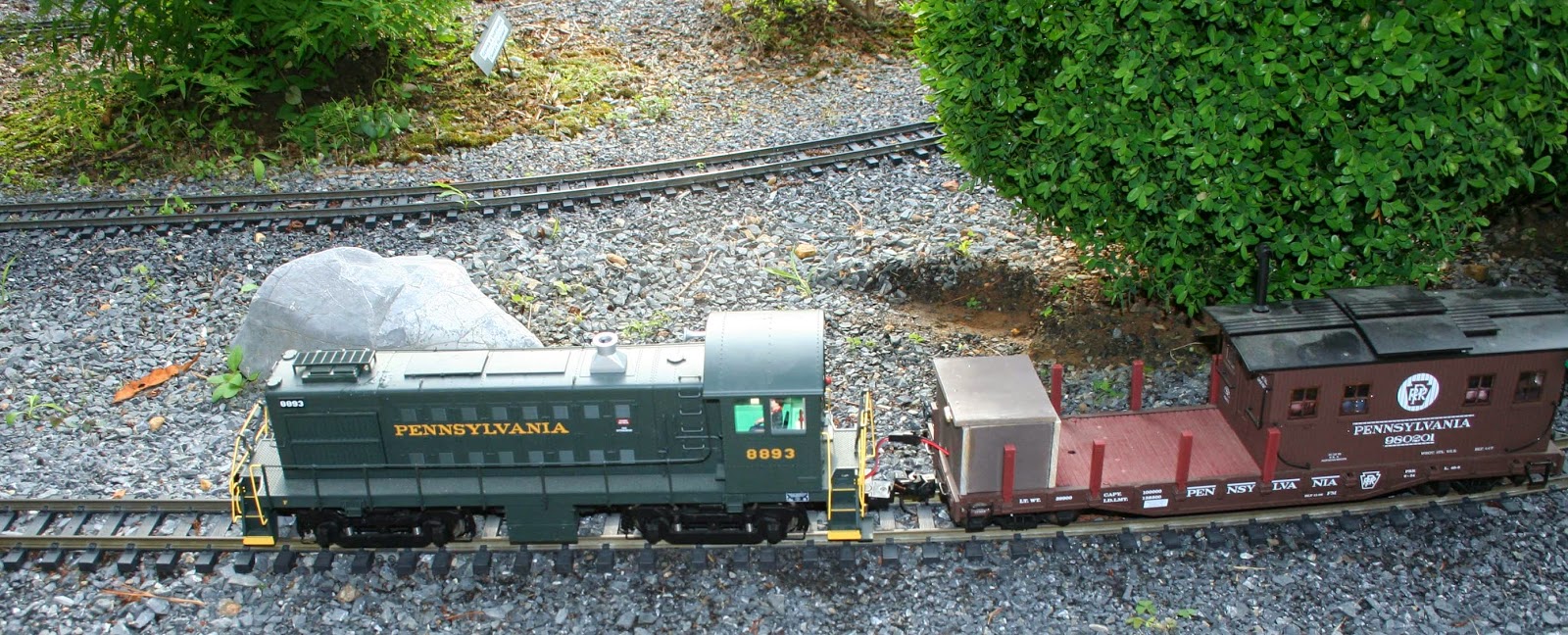
One of Bob's trains

Hyatt’s career experience and Master Gardener training prepared him for giving both turfgrass management and landscape gardening workshops.
For this Franklin County Master Gardener, his life-long interest in trains and pleasure in landscape gardening merged into his Clark’s Knob Freestyle Garden Railroad.
This year for the first time, Hyatt will be holding a “Beginning Railroad Gardening” workshop on Saturday, June 28 from 9:00 to 11:00 a.m. Participants will learn the "ins" and "outs" of this unique style of gardening at Hyatt's home on Shives Lane. 

The workshop will provide information on starting a railroad garden as well as designing a layout and adding the finishing touches.

World's oldest railroad garden, Bekonscot Model Village, England, est. 1929

 The popularity of having train models follows the history of railroading as people sought to bring some of the excitement into their own homes and yards. Moving from large outdoor trains to small sized and toy indoor models, around 1970 trains began to be designed specifically for use outdoors - rugged with the motor parts enclosed.

“It’s not a cheap hobby,” said Hyatt, who has been adding to his layout since 2002. He currently has about 400 feet of track in three loops and uses “G” gauge (1/29th scale) trains and brass track.
Deciding what kind of railroad garden is a first step. Some railways may just meander through the existing normal-sized plants in a yard or garden. Other railways are stationed at a village and may even have a theme such as the Old West or a logging or coal town. 
Bob Hyatt adjusting his homemade coal factory

Hyatt used stones from his property to build a number of walls and focal points. He uses brass track which weathers while the stainless steel stays bright. “I like a more natural look,” he said, noting that he does have houses to put out in an area alongside the track.
One of the many beautiful succulents Bob has available
To maintain a realistic scale, the plants he uses are typically dwarf varieties or small succulents. After finding plants for his layout, Hyatt has expanded into a small business selling these types to other outdoor railroaders as well as miniature container and fairy gardeners.


He has had several Open Houses. “It’s a lot of work to get ready for an open house and some friends come and help.”
Open House 2013
This is when friends and family visit Clark’s Knob Freestyle Garden Railroad and can appreciate how Hyatt has coupled two of his favorite hobbies.

Some links of interest:

Bekonscot Model Village


Tuesday, March 25, 2014

Make Your Own Miniature Landscape (Fairy Gardens) Sat., March 29

by Carol Kagan

You've seen these miniature gardens with different themes - gnomes, Asian homesteads, fairies and even Lord of the Rings. You've wanted to make one but didn't know where to start. Here's the answer and a way to spring into spring since the weather won't let us!
After the very, very successful presentation on February 1, Juanita Kauffman is offering a Make and Take Workshop on two dates: Sat., March 29 from 9 - 11 a.m. and Tues. April 8 from 6:30- 8:30 p.m. at the Ag Heritage Center, 181 Franklin Farm Road, Chambersburg.

This workshop will go over the guidelines for these miniature gardens but will be a hands-on presentation where participants will make their own to take home.

All supplies are provide including a made-in the-USA beautifully glazed, 13 1/2" pottery bowl, soil, gravel, 2-4 appropriately scaled plants and 2-3 tiny accessories.
Kauffman will participants put all these elements together to make a miniature gardens that will be a conversation piece and provide hours of enjoyment.

The cost is $50 - a great value for these quality supplies and workshop guidance.

For information or to register, call 717-263-9226.

Friday, March 7, 2014

Upcoming Master Gardener Workshops and Events

by Carol Kagan, Master Gardener
We've pruned little plants at the Bonsai program and big ones at the pruning workshop. We've sowed our winter seeds and built indoor seed starting set-ups. We've found out how to lure and keep both birds and bees. Now what?

Master Gardener Workshops & Events                    March, April & May

These are held at the Agriculture Center, 181 Franklin Farm Road, Chambersburg. For more information, to register, or to be added to the e-mail event schedule list, please call 717-263-9226.

Sat, March 15- Backyard Fruits-Small Fruits & Brambles: 9-11 am
 
Thu, March 20—Deadline to order strawberry plants to support 4-H Gardening Club- call the office -$7 for a bundle of 25


Thu, March 27 - First meeting of 4-H Gardening Club: 6:30 pm - Youths 8-18 welcome w/parents
 
Sat, March 29- Miniature Landscaping (Fairy Gardens) Make & Take Workshop: 9 -11 am - all materials included $50 - Limited number
 
Tue, April 8 - Repeat of March 29 Workshop: 6:30-8:30 pm - Limited number

Thu, April 3- Intro to Growing Vegetables  (Growing Vegetables series): 6:30 - 8:30 pm
 
Weds-Thurs Apr 9 & 10: Strawberry plant pickup
 
Thu, April 24- Gardening w/Fewer Pesticides: 6:30- 8:30 pm
 
Sat, April 26- Starting an Herb Garden (#1 Herb Series): 9 -Noon
 
Sat, April 26- Native Woodland Plants: 1-3 pm (off-site in Blue Ridge Summit)
 
Thu, May 1- All About Tomatoes (Growing Vegetables series): 6:30-8:30 pm
 
Sat, May 3- Container Gardening-Kid friendly!  (Good Garden Practices Series): 9-11 am
 

Fri, May 9- Vegetable Plant Sale: 10 am - 2 pm

 
Sat, May 10- Backyard Water Features: 9-11 am
 

Sat, May 17- Plant Sale: 9 am- 1 pm

 
Visit our Blog ( franklincountymgs.blogspot.com )

Saturday, February 1, 2014

Fairy Garden Workshop Draws Big Crowd

by Carol Kagan, Master Gardener

Detail from a miniature container garden (Photo: J Kaufman)
“Look closely. The beautiful may be small,” said Master Gardener Juanita Kaufman, quoting Immanuel Kant.


The crowd found Juanita to be enthusiastic and a good presenter.

Fifty four people came to the February 1 workshop “Fairy Gardening,” to look at and learn how to create small gardens. Brenda Hollar, a Master gardener from Washington County, Md., came because she wants to make one.

Kaufman’s enthusiasm and experience in making fairy gardens were evident. “I’m not actually gardening. I’m just having fun,” she said. Her displays included several of her container gardens, her handmade houses, and the outdoor accessories she brings in for the winter.
Kaufman made these out of a coffee can (L) & bleach bottle (R)
Although called fairy gardens, these miniature displays can also feature gnomes or, let your imagination go to small animals or different people. "You determine what your world looks like," Kaufman said.
Examples of accessories that can be used
Miniature gardening also includes bonsai (bone’-sigh) and railroad gardening. A Master Gardener workshop on bonsai is scheduled for February 22. The railroad gardening this year will be held off-site at a railroad garden and is planned for early August.

An outdoor garden (Photo: J Kaufman)


These gardens can be in a container or in ground as part of an outdoor area. Containers can be moved outside during the growing season and can enhance a patio, porch or any area of a garden.


Kathy Rogers, Waynesboro, likes the idea of the small gardens. She plans to make a container garden and “start small.” Andy Junker, Chambersburg, said her active life includes a lot of travel and an indoor container wouldn’t work. She may try to incorporate one in her outdoor landscape.

Kaufman went through various steps to create a garden. She noted her experience, including mistakes made and corrected, as she went from choosing a site (and where not to put one), a theme and the scale (look before you buy). Site preparation includes thinking about access to utilities and the garden itself (small enough to be ‘reachable”).


Linda Shuey came from Carlisle with her husband. She liked the “do’s and don’ts” Kaufman included. “And my husband seems to be fascinated, too,” she added.

“Kids that never grew up and got out of the doll house love these,” Kaufman said, noting that “there is a sense of magic and whimsy.”
A very small fairy garden
Seeing these fairy gardens as a wonderful way to create a childhood experience, Marlene Schlusser, Carlisle, has already tried two. “I know I need a lot of help,” she said, noting that she likes all the miniature items. “Scale may be” a problem she has to consider.

“Children love these things — they’re drawn to them like magnets,” Kaufman said. Nancy Pollard, University of Illinois Extension horticulture educator, says creating an indoor fairy garden can get children interested in gardening and nature, and, some creative teachers have incorporated exchanging notes with the fairies in their class activities.

Justin Lindley, Hagerstown, attended because his daughter Faith, 7, along with her younger sister, is interested in creating a fairy garden. “They like it all,” he said, indicating that picking a theme would curtail them from buying everything.

Prune these plants or they will overtake the tiny adobe house.
Some designs require “teeny, tiny plants” to keep with a very small themed design and the mature size of plants should be considered. “You have to keep [the plants] small. Otherwise, it may seem like a creature feature where the plants ate the house.”

Anne Boggs and daughter, Storie, Chambersburg, came to learn how to make these. “My daughter is interested in making a garden, probably along a Lord of the Rings theme,” said Boggs, adding “Her birthday is coming soon.”
Anne & Storie Boggs plan to make a container garden
Kaufman also included information about the care and maintenance of your creations, emphasizing careful watering techniques and pruning. For areas outside, watch where you drag the hose or the lawn mower exhausts.

Like most of those present, Hollar said at the end of the workshop that she learned how to make a fairy garden and she will try. Perhaps she will be able to give a workshop in Washington County and spread the knowledge.


E-mail notification of workshops and events - send your e-mail address to the Extension Service office at jlw69@psu.edu. You may also register for workshops by e-mailing or calling the office at 717-263-9226
 
Check these links for more information
 
Rusk County, TX Master Gardeners: Designing a Fairy Garden
Univ. of Illinois-Urbana: Fairy Gardens
PA Herb Festival Workshops: Garden in Miniature - 
workshop - all supplies included
Rosemary House, Mechanicsburg, PA: Fairy Festival

And for those who wanted it, Juanita has generously agreed to share her Grandmother's zucchini bread recipe.

Wednesday, January 30, 2013

Grooming Brooming

Witch's Broom on Norway Spruce
Picture courtesy of Garden Professor Bert Cregg
A commenter over at the Garden Professor’s Facebook page linked to this article about Witch’s Broom, and the intrepid conifer enthusiasts who climb trees, risking life and limb to harvest them, with the hope of finding a source for the next great dwarf cultivar, so beloved of Railway, and Fairy Garden enthusiasts, and even home landscapers wanting a slower growing, denser leaved, and smaller specimen for their landscapes. From the article:
Hermsen and Larson are part of a tiny group of plant fanatics — they estimate they number about 200 nationwide — who traipse through forests collecting witch's brooms. The term, which dates to the Middle Ages, refers to tree mutations made up of dense masses of shoots growing from a single point. They look like balls of twigs woven together and can grow to several feet across. Each is the only one of its kind in the world. They are genetically unique.
They were dubbed "witch's brooms" in Medieval Europe because it was believed witches placed them high in trees, and even rested in them.
Intrigued, I started googling around, and found some interesting stuff about Witch’s Brooms.

Here’s Garden Professor Bert Cregg:
Witch’s brooms are growth anomalies that occur on various trees, most commonly conifers, Brooms can be caused by a variety of factors including diseases, aphids, environmental stress and random mutations. In some cases the growth defect is only present when the causal agent, say, a pathogen is present. In others, however, the growth mutation can be propagated by grafting scion wood from the witch’s broom onto a regular rootstock. In fact, this is the origin of many forms of dwarf and unusual ornamental conifers. Because of this, brooms are often a prized commodity and ‘Broom hunting’ is an active past-time for conifer enthusiasts such as members of the American Conifer Society.
Here’s his Fact Sheet on Spruces, and some of the cultivars originally gleaned from a naturally occurring Witch’s Broom.
‘Nidiformis’, the Nest Spruce, which itself was a witches’ broom that had been found on a Norway Spruce. Photo Credit Bill Barge
Whenever someone walks through a collection of dwarf, contorted, drooping, variegated, or otherwise unusual conifers such as the Harper Collection at Hidden Lake Gardens, one of the first questions is “Where did these trees come from?” In a few cases the trees represent relatively rare species that we don’t see often in this part of the world. However, in most cases these unusual trees represent genetic mutants of otherwise common conifers such as Pinus strobus, Picea glauca, Picea abies, Tsuga canadensis or other run-of-the-mill species. The trees we see in collections that are prized by conifer connoisseurs are the result of genetic mutations that result in unusual color or variegation, extremely slow growth rate, or loss of apical dominance. The mutations usually happen one of two ways: seedling mutants or witch’s brooms. Seedling growers that grow tens of thousands of seedlings from a given species will occasionally find individuals with unusual growth characteristics such as variegated or weeping form. Scions from these trees can be grafted onto other seedlings to propagate trees with the unusual trait. Likewise, mutations can arise within an individual tree. These are called witch’s brooms or “sports”. The unusual trees are propagated by grafting scions from the witch’s broom onto seedlings. If the mutation results in a weeping form, different forms of the tree can be produced depending upon where the scion is grafted. Grafting high on the normal tree (or standard) results in a weeping form, whereas grafting at ground level results in a prostrate or low growing form.
It’s not just conifers, either. The spotlight specimen in the Gass Garden, is a Vine Maple, Acer circinatum, first described during the Lewis and Clarke Expedition.

Witches Broom of Vine Maple - Photo Credit Harold Greer for Oregon State University
There’s a dwarf cultivar of A. circinatum named ‘Little Gem’ that was originally discovered as a witch’s broom.

A. circinatum 'Little Gem' - Picture courtesy of Oregon State University
Serendipitous web surfing can be very enlightening.

Wednesday, January 2, 2013

Gardening in Miniature

“Look Closely, the Beautiful May Be Small”  Immanuel Kant

Fairy Garden Booth at the Ass'n for Horticulture Professionals
Trade Show in August. Picture courtesy of Holly Scoggins
Two of the fasting growing hobbies in the horticulture world are Fairy Gardens and Railway Gardens. Consumer horticulture writer George Weigel recently noted the phenomenon in his "Trends for 2013" video, which you can view here. Garden Professor Bert Cregg of Michigan State University has also commented on the trend, and recommends this article from Digger Magazine on Railway Gardens.

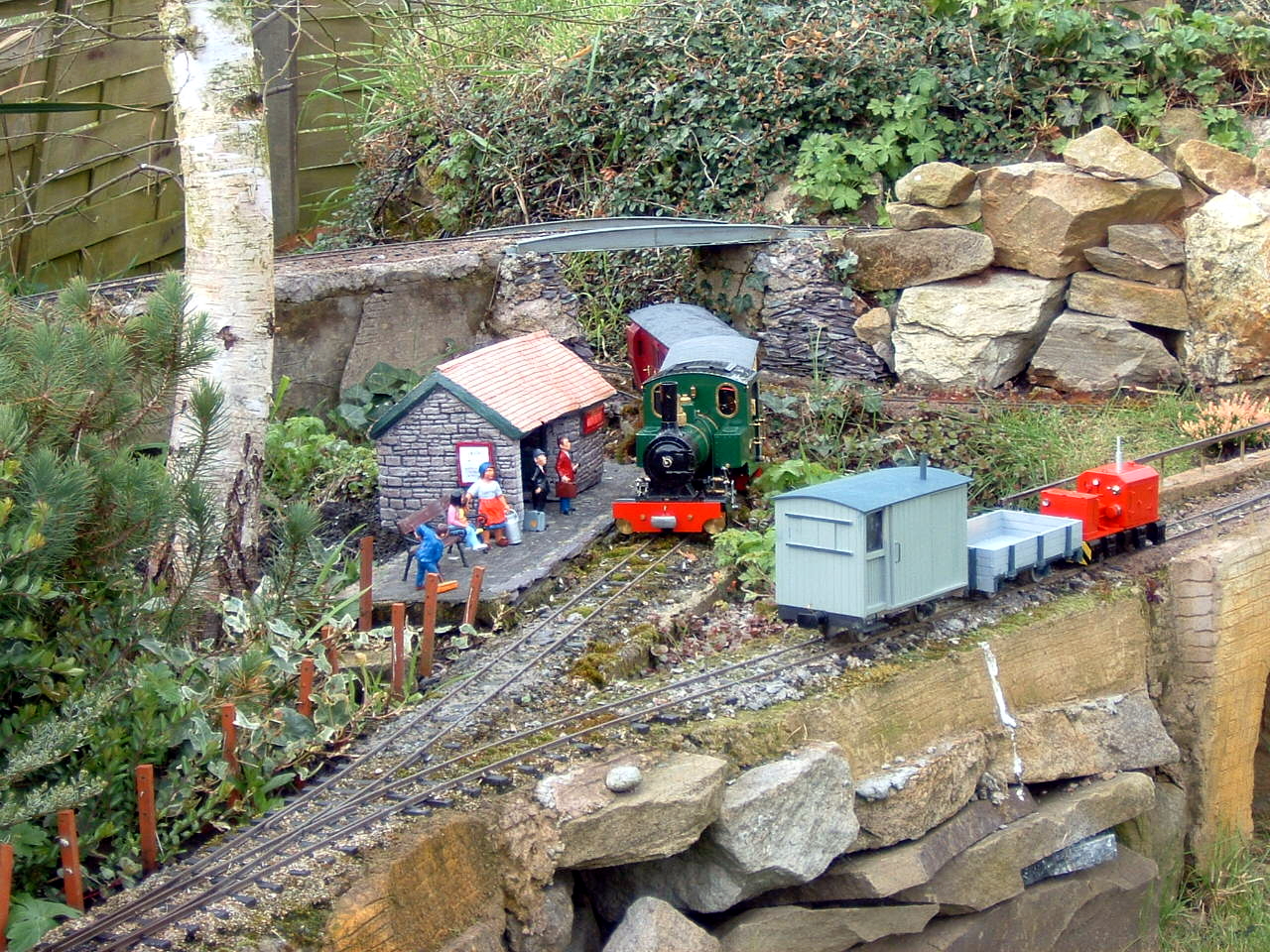
Scene on a typical 32 mm gauge UK garden railway
Picture Courtesy of Wikpedia Commons
Fellow Garden Professor Holly Scoggins of Virginia Tech attended a trade show in August of this year, and noticed the proliferation of Fairy Garden plants and paraphernalia.  The eXtension Master Gardener blog has a recent post up about some cool conifers that work well in these environments.


Luckily for us, Franklin County Master Gardeners Juanita Kauffman (Fairy Gardens) and Bob Hyatt (Railway Gardens) have been enthusiasts for the hobbies for several years now, and have put together a workshop to share their knowledge with the public. Come to the Saturday, January 12th workshop from 9:00 - 11:00 a.m. to learn proper selection, care and maintenance of dwarf, compact, slow and low-growing, or tiny-leaved plants best suited for miniaturized landscapes, as well as general information about these fast growing hobbies.  The fee is $10.00. Contact the Extension Office at 263-9226 to register.

Pinus banksiana 'Uncle Fogy' Taltree Arboretum (Indiana)
Photo credit: Foy Spicer
Locally, Appalachian Nurseries, a wholesaler of landscape trees and shrubs, also has a retail business specializing in dwarf, or small leafed, slow growing plants for use in these miniaturized gardens and landscapes.

And the Mainline Hobby shop in Blue Ridge Summit caters to the model railroading marketplace.

Update:  Click to see pictures of Bob's Railway Garden.