Thursday, September 16, 2010

Another Hummingbird Moth


Nancy Miller sends us these pictures captured by her husband, Larry, of a White Lined Sphinx Moth, or Celerio lineata, another one of the Sphinx, or Hummingbird moths in the Sphingidae family and are usually called hornworms in their larval, or caterpillar stage.  Writes Nancy:
"This whitelined sphinx or hummingbird moth, has been gathering nectar on this lantana for several weeks.  Larry took this picture of me holding a stem and the moth came right up and was sipping nectar from the flower.  Then it visited a petunia right above my arm, and I could feel the air from the fast beating wings.  This was a way cool moment. "
I'll say!  More pictures follow:


Here is a picture of the caterpillar, courtesy of Iowa State University:


You can visit Nancy's backyard habitat garden by attending our Autumn Stroll garden tour this Sunday, September 19th from 12:00 to 5:00.  There will be a plant sale at that location as well.

Blue Birds Bathe


Evelyn sends this adorable picture of what looks to be recent bluebird fledglings enjoying a bath.

Tuesday, September 14, 2010

An Autumn Stroll

This Sunday, September 19th from 12:00 to 5:00PM, come and enjoy a tour of 10 gardens in the Chambersburg area.


“This year's offerings represent a well-rounded display of visually appealing gardens that showcase varying aspects of gardening and landscape design,” explains tour coordinator Georgena Ruth.  “You’ll see sun and shade gardens as well as simple and complex landscape structures.  Watch for new insights into companion planting, turf management, and garden accenting.  There's plenty to see!”


“In my Backyard Habitat I have trees and shrubs that produce berries, a fountain for water, evergreens for shelter and a brush pile for cover,” explains Nancy Miller.  “I also have several bird feeders that provide food for birds and squirrels and a small dish to provide water for toads.  But another benefit is the enjoyment we experience viewing wildlife in a natural setting. It doesn't get any better that that!”


“The design of our landscape was created with an emphasis on water staying on the property,” explains Nancy Redington. “We had leach beds constructed to handle the water from the gutters. They’re under all the gardens, and the water flows from one level to the next through pipes and gravity. We also have a fish pond that is a perfect eco-system: we never feed nor add any chemicals.”

The Redington garden is also notable for its many roses.
"Although some may consider roses high maintenance, spraying is done just for fungus. Our sod has effectively been treated with Milky Spore Disease to protect it from Japanese Beetles. And the trees and garden placement have been designed to allow maximum air circulation to minimize fungal problems. Even though there is a heavy concentration of roses, the other types of plant material have been chosen to give diversity and health to the landscape.”


“Our ultimate plan for the garden was to have something blooming from early March with crocus and daffodils, through November when the last Rose blooms,”
Tickets for "An Autumn Stroll" are $10 apiece, with proceeds to go toward the educational programs presented by the Master Gardeners. Day-of-Tour tickets will be available at the Redington Garden at 347 Leedy Way East, Chambersburg, 17202. To purchase tickets in advance, or for more information concerning the Master Gardeners’ “Autumn Stroll”, call the Penn State Cooperative Extension office at 717-263-9226.

Monday, September 13, 2010

The Last Hoo-Ra!

I always feel a little sad this time of year when I go out to the Pollinator Garden.

I can see a difference in the behaviour of all the pollinators

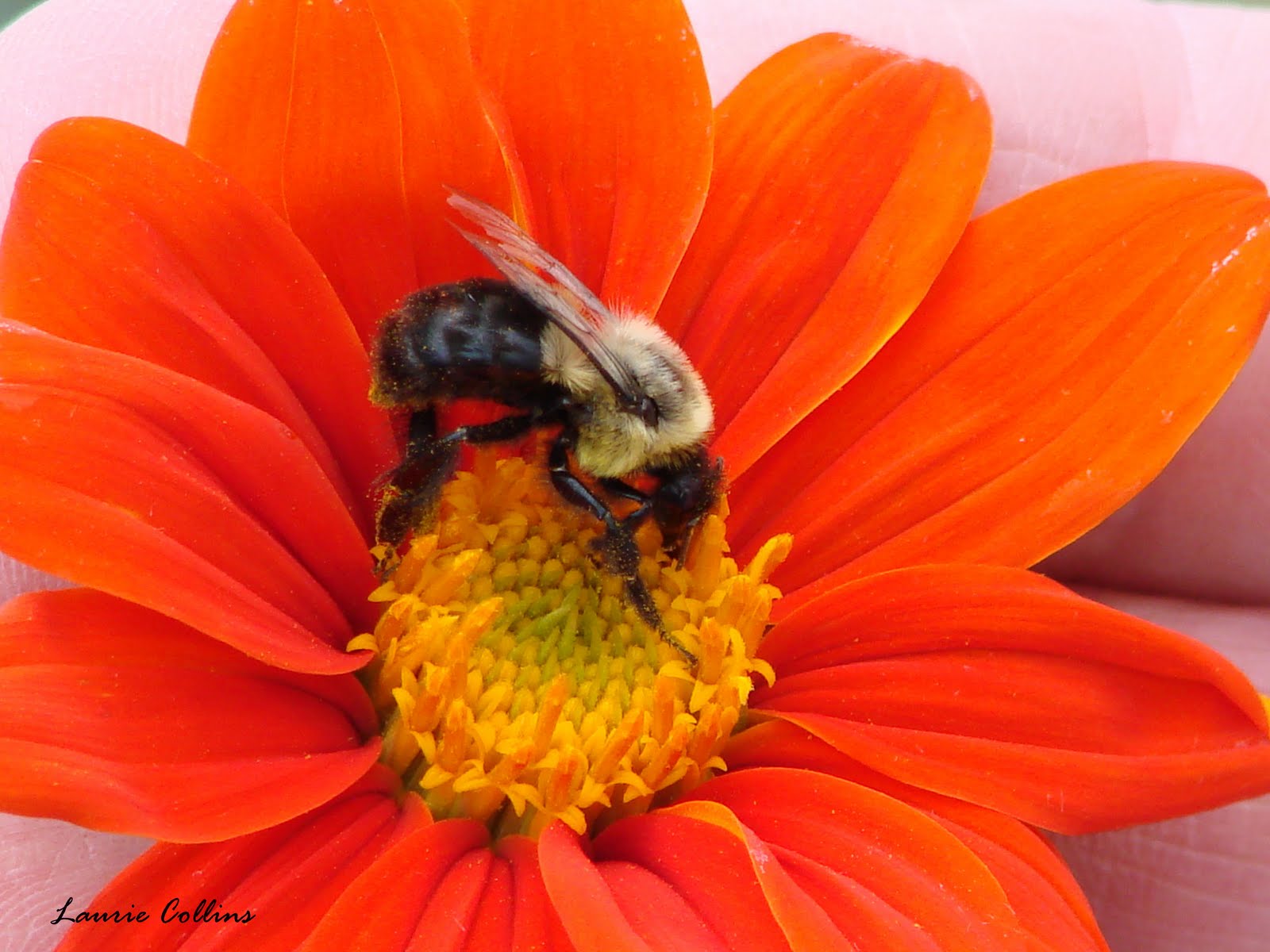
When the Sedum starts blooming, I know I'm seeing the final weeks of the bumble bees.

And butterflies.
The Hummingbirds will be making their migration soon.
The bees are moving slower.  And everybody's sharing flowers.


For the past two years, the Digger Wasps have shown up in September to 
do whatever it is they do each year on the Giant Chives and Sedum.

This year, they brought a friend.

I suppose the word is spreading about late season treats that grow here.


I know when the sunflowers have grown tall.....

and the Asters are beginning to bloom.....

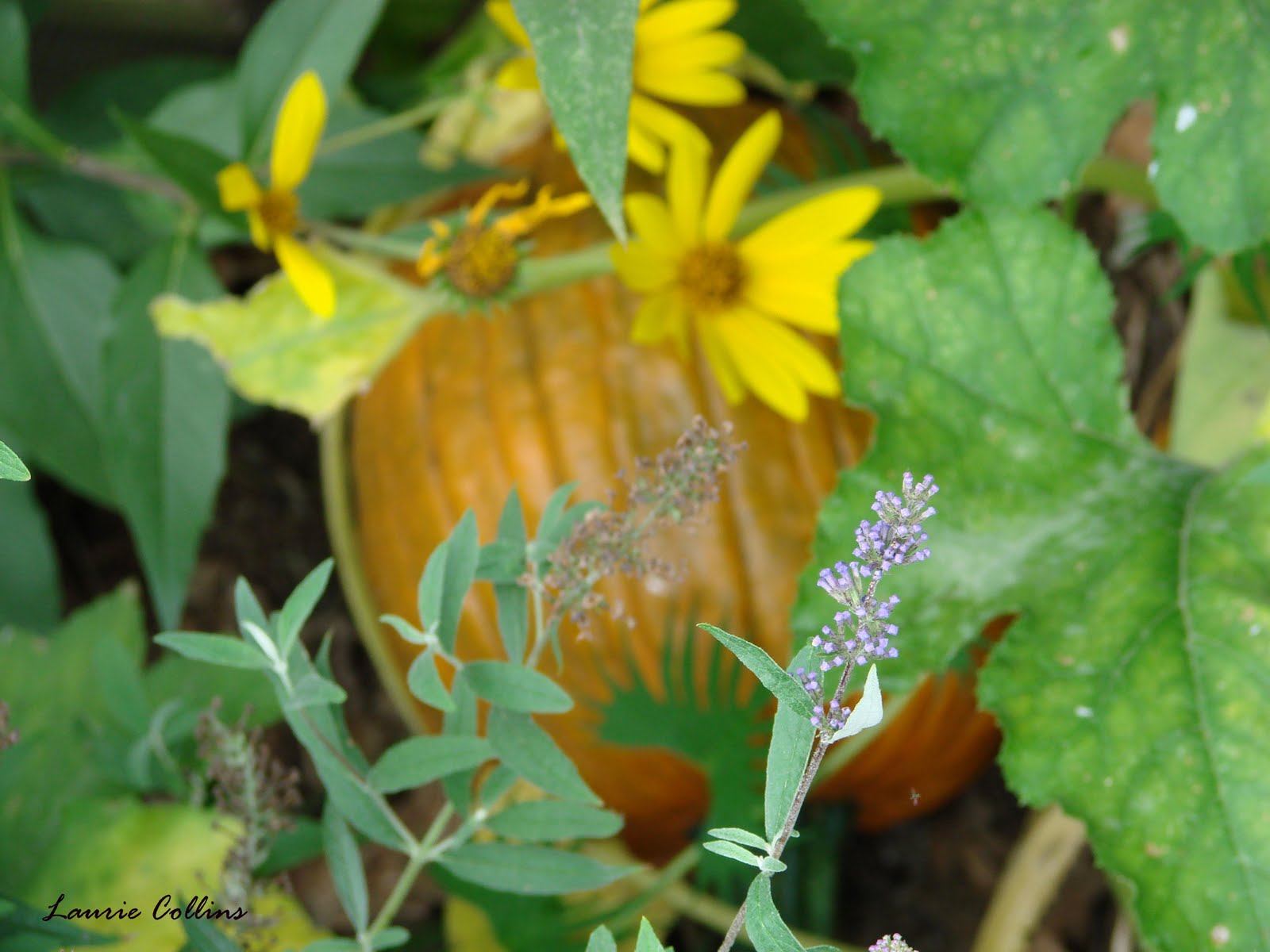
and last year's pumpkin seed has given birth....

I will soon have to say goodbye to my little friends.

But I'm sure glad they have a place to come for one last Hoo-Ra!

Friday, September 10, 2010

Colorful Autumn Garden (Part 2)

As you are learning, the end of the summer doesn't have to mean the end of your colorful garden. There are plenty of options for your garden with fall-blooming flowers and shrubs. Fall gardening will put you in the spirit of the season, and is a superb way to enjoy the beautiful outdoor weather before the frosty wintertime sets in and you'll rather be looking out at your lawn through a window with a cup of hot cocoa.  Here are more of my favorite fall bloomers.  (You can click on any photo to get a larger image; hit back to return to article.)

Eupatorium coelestinum
Hardy Ageratum (Eupatorium coelestinum 'Cori') provides wonderful blue color in the fall and looks so good at that time I would never want to be without it. The plant emerges late in the spring as small attractive green leaves and slowly grows to its full size of 3’, flopping and spreading all the time.  If you do not deadhead, you will have many seedlings next spring.  The seedlings are easy to weed out or transplant.  While hardy ageratum prefers full sun, I have many growing in part shade.  Eupatorium coelestinum 'Alba' is the white specie and is just as beautiful.

Ceratostigma
Ceratostigma (Leadwort, Plumbago)  is a  semi-woody, mat-forming perennial which spreads by rhizomes to form an attractive ground cover. Like many nice groundcovers, it can be somewhat invasive in optimum growing conditions.  These plants add a leafy green texture to the garden in summer, electric deep blue flowers from mid-summer on, and couldn't be prettier in autumn with its reddish leaves.

Buddleia 'Blue Chip' and Gomphrena 'Fireworks'
Buddleia 'Blue Chip' and Gomphrena 'Fireworks' continue with their beautiful blooms. Both are new on the gardening scene this year.  While most buddleias require deadheading for continuous bloom,  Blue Chip has been blooming since mid summer and hasn't stopped, without deadheading.  Fireworks was slow to start, but is now exploding with color.  Your choice of buddleia is almost endless.

Chelone
Nick-named for their blossoms shaped like a turtle's head, Chelone is a carefree fall blooming perennial whose only real dislike is excessive dry heat. Chelone behaves itself, growing in a dense clump with attractive foliage and red, pink or white blooms.  An added bonus, Chelone is self-cleaning

Anemone
Fall-blooming anemones also bring a touch of beauty to the autumn garden scape when delicately beautiful flowers burst open atop the plant’s willowy . The white and pink blossoms illuminate the shade garden, especially at dusk.  Newly opening blossoms mingle among the seed heads, providing a lovely show for several weeks between late July and October.  In favorable conditions, anemones will self-seed freely.

Hibiscus syriacus 'Diana'
Hibiscus syriacus 'Diana', a rose-of-sharon cloaks herself with flowers as lovely as the Greek goddess for which she is named. Lovely, large, pure-white flowers produce little or no seed so troublesome with many hibiscus syriacus.  Thus, 'Diana' will bloom continuously from late June until frost.  I shear Diana back each spring  to about 5' as she blooms on new wood only.

Remember, fall bloomers can get very tall and leggy growing foliage all summer. Once they bloom, they are often top heavy and fall over. To ensure your fall display is as glorious has it should be, you will either need to stake your fall bloomers earlier in the season or do some periodic pruning to make the plants stockier and more self-supporting.  Keep in mind that if you prune your plants, you will be delaying the bloom period by a week or more.

Two books I highly recommend for seasonal gardening:
Time-Tested Plants by Pamela J. Harper and
Continuous Bloom by Pam Duthie.

Colorful Fall Gardening, Part 1

Colorful Fall Gardening, Part 3
Colorful Fall Gardening, Part 4 

Tuesday, September 7, 2010

Can 'em Juice 'em Dry 'em Freeze 'em

Canning efforts - Winter Squash (patty pans and butternuts)
 and some Holy Mole peppers in the back
People often ask me what I do with all the stuff I grow, aside from sharing with friends, neighbors, and fellow congregants. I can 'em, juice 'em, and dry 'em. Best fruits get canned, others get juiced. Leftover grape varieties, and two small plum varieties - Black Plum, and Principe Borghese are dried, along with a yellow paste variety I grew this year - Golden Mama (prolific producer, BTW) which gets both canned and dried.

Other good varieties for canning that I'm growing include Pittman Valley Plum, Amish Paste, and San Marzano. Slicers make poor candidates for drying, shriveling up to almost nothing, OK to good for canning, but are best for juicing, along with extra cherry varieties, like sun gold and black cherry - 2010's winners for Tomato Day.


Canned Tomatoes and Peaches -
Dried tomatoes in front

I cut up all the juicing ones, add whatever extra vegetables I have around (eggplant, squash, carrots, etc.), add peppers (sweet and hot) and onions. Simmer and sieve through a foley mill. Excellent V8 base for a bloody mary. Once there's a bit of a frost, I harvest a couple of horseradish roots and shave a bit into the glass, shot or two of vodka, and Voila, a beverage for Sunday brunch. Yummy.


Tomatoes in Dehydrator
Drying involves just cutting the tomatoes and placing them on a rack in the dehydrator. New this year - putting some of the tomato juice on the plastic sheet for fruit rollups in the dehydrator, and making my own tomato paste. Scrape into a freezer bag and freeze. Also new this year - garlic and onions in the dehydrator. Once dry, grind them up in a coffee grinder, and then package in a freezer bag and freeze. I've done paprika and cayenne peppers this way before.


Onions, Garlic, and Thai Peppers
This is my first year for growing garlic, and some of my onions in years' past rotted (I like to grow the sweet ones, and their storage life is limited), so I figured this was a way to prevent that. The ones in the picture are a variety called 'red zeppelin' - cool name, huh?


Pantry shelves filling up.

I also bought a 1/2 bushel of peaches and canned them, along with the tomatoes.

Monday, September 6, 2010

Who Knew? Not Me!

My new shrub brought a guest home...a praying mantis.  I got out my camera, of course, for a closeup picture then decided to do some research. 

I was always under the impression that praying mantises were "THE" insect to have in your garden and if you were ever to kill one, the insect police come after you.  Well, let's put that myth to rest.  According to Penn State College of Agricultural Sciences praying mantises or mantids are not protected by federal law.

I was under the impression that the female praying mantis would bite the head off her male partner after mating.   This cannibalistic act was once believed to be a regular practice. However, it now seems likely that it is much rarer in female mantises in the wild than in captive mantises kept in a cage.  Another myth proven untrue.

I was also under the impression that mantids are active predators and consume other "bad insects". Well, they are good garden predators, but are cannot keep up with the population growth of some insect populations and do not discriminate between beneficial and harmful garden insects.  While the praying mantis feeds mainly on other insects it is, however, documented that larger  mantis are able to consume small reptiles and even small mammals or birds.  These praying mantis facts are well documented in many praying mantis videos.


Prayingmantis.org had some very interesting facts:
Praying mantises have triangular-shaped heads and a compound eye on each side of their heads. They are the only insects that can turn their heads a full 180 degrees, and some species can turn almost 300 degrees without moving the rest of their bodies. They're also very sensitive to movement and can see something move up to 60 feet away.

Another one of the praying mantis facts is their ability to use their camouflage to blend in with the surroundings and wait patiently, sometimes for long painful minutes for their prey to reach striking distance. They then use their vice-like front legs to quickly snatch the victim and devour it alive.

When threatened, the praying mantis will stand tall and spread their forelegs with their wings fanning out wide and mouths open. This defensive stance is used to make the praying mantis seem larger, so that it can scare the opponent, with some species having bright colors and patterns on their hind wings and inner surfaces of their front legs for this purpose. If the harassment from the attacker persists, the mantis is in the position to then strike with their forelegs and attempt to pinch or bite.

As part of the final praying mantis life cycle stage often does not develop wings until the final molt. Some praying mantis do not develop wings at all, or may have small wings that cannot function for full flights, just short and jumping bursts. The praying mantis will often fly when the adult female begins to emit pheromones which attract males for mating.

The male praying mantis often fly at night as they seem to be attracted to artificial lights. This is a time however, when bats feed and they use their ultrasonic sound waves to track their prey. Bats are one of the mantids most formidable natural enemies. The frequency of these ultrasonic sound waves can locate the distance of the bat's prey. Interestingly enough, according to Yager and May, praying mantids are able to hear these ultrasonic sounds and when the frequency begins to increase rapidly, indicating an approaching bat, the praying mantis will stop flying horizontally and take a nose dive down vertically at an incredible speed towards the safety of the ground. This sudden descent will be of a downward spiral or an acrobatic loop motion. This is one of the praying mantis facts that I have yet to see in the praying mantis videos. It is believed that the praying mantis' one single ear serves the sole purpose for detecting and dodging these type of bat attacks. Again these are another of the one of the things that make the praying mantis a most fascinating insect.
Even though the praying mantis is not the perfect garden angel I thought it was, it is nature's way to maintain that ecological balance required for responsible, successful gardening. I will, however, keep a closer eye on my hummingbird feeders!

Sunday, September 5, 2010

Ailanthus Webworm Moth

Also known as Atteva punctella   This picture was sent in by new Master Gardener trainee Mary Crooks.  Alex identified it, and linked to this University of Arkansas Fact Sheet:
The colorful adult Ailanthus webworm moths are pollinators, often seen visiting flowers of many different species during daytime. They mate at dawn and lay eggs at dusk, primarily on fibrous substrates, such as the larval webbing. Larvae of various ages feed gregariously on leaves, flowers, seeds, and even bark.
As the common name indicates, the larval host plant is the invasive species Ailanthus altissima, or Tree of Heaven.

Go Moth!

The fact sheet also uses two terms multivoltine and diapause that are useful in understanding insect life cycles.  A multivoltine species has multiple broods in one season - that is the female of the species lays eggs multiple times during its adult life span.  That's an important characteristic in disease transmission from mosquitoes.  Some mosquito species are univoltine - they get a blood meal, lay eggs once, and die.  We in the vector disease management field don't worry too much about these gals, since any pathogen they pick up in the process of getting a blood meal, won't be passed on.  The multivoltine mosquito species, however, drink, lay eggs, and then go seek another host - up to 4 times in some cases.  That's how a disease, like the West Nile virus, gets transmitted.

Diapause is an insect version of hibernation, going into a slowed down metabolic state to wait out adverse environmental conditions.

The Ailanthus moth is described in the fact sheet as a multivoltine species that apparently does not diapause, concluding:
It is unlikely that it overwinters in the northern part of its range. Rather, it migrates north across the United States to southern Canada each year.

Friday, September 3, 2010

Colorful Autumn Garden (Part 1)

Soon the leaves will start to turn the most beautiful shades of red, yellow, rust, and orange;  and soon our main gardening tool will be the leaf rake.  Soon it will be time to put the lawn mower to rest and prepare for our long winter's nap to only dream of spring gardening.  Well, not for this gardener!  When August is through, it's not time to give up on your garden.  Autumn is one of my most favorite times in the garden.  In my "Colorful Autumn Garden" series, I will share with you some of my most successful fall beauties in the order of bloom time.  So let's roll up our sleeves and get ready to design your beautiful fall garden.

Caryopteris with Limelight and Helianthis
Shrubs play an important role in any season, but fall shrubs sure know how to strut their stuff just when color is needed. The low mounding habit of Caryopteris (blue mist shrub) makes it perfect as a low border plant for massing purposes and works wonders in dry, sunny spots.   Blue mist is a deciduous shrub that has bright blue to purple, late summer flowers that attracts butterflies and honey bees. Flowers appear on new growth, so cut back hard to the ground early each spring.

First blush on Limelight
Hydrangeas are a most beautiful shrub; their ease of care, adaptability to a wide range of climates, and the long season of beauty of their flowers from May through November has endeared them to gardeners.  The key to growing beautiful hydrangeas is selecting the right hydrangea for your garden's needs.  Limelight, Little Lamb, Tardiva require very little care and reward you with beautiful flowers from midsummer through their fall blush.

Leycesteria formosa
These unusual flower bracts belong to the Leycesteria formosa.  The full- part-sun Leycesteria formosa's chartreuse foliage has reddish new growth. flowers are held in drooping clusters of deep red bracts, later followed by showy purple-black edible berries, said to taste like toffee.The dark purple fall fruit does indeed attract pheasants and other wildlife.  Sometimes known in England as Pheasant Berry because pheasants are said to gobble the fruit. In our area pheasant berry is a die back shrub that likes to be mulched for winter.

Begonia grandis with painted fern and hakonechloa
Begonia grandis bears green heart-shaped foliage with red veining and claret-stained undersides that steal the show when backlit. Pendent clusters of slightly fragrant, satiny pink or white blossoms open from midsummer until frost. It makes a good perennial companion for ferns and hostas.   Hardy begonia prefers rich, moist but well-drained soil in moderate or full shade, with shelter from afternoon sun. Hardy begonia dies to the ground in winter and often reseeds to form large colonies.


Helianthus with castor bean
Helianthus 'Lemon Queen' is a back-of-the-border perennial.  Plants are tall and upright, forming a bushy clump of branching sprays of soft yellow daisies in  summer and fall.  Excellent for cutting, this perennial sunflower can reach almost 8 feet;  but is easily be pinched in June to keep at a lower height.  Clumps are easily divided in early spring.  As if the beautiful flowers weren't enough, the flowers are butterfly magnets.

Monch aster
Everyone knows and loves the asters that bloom in fall, but there are as well a handful of summer bloomers that are valued for their bright blue flowers and their exceptionally long bloom time. The best of them is A. x frikartii  'Monch'. Its graceful 2-3ft stems bear masses of 2.5-in flowers all summer through fall in an extraordinary shade of lavender blue.  Best of all,  Monch does not require deadheading to remain beautiful.

Fall bloomers can get very tall and leggy growing foliage all summer. Once they bloom, they are often top heavy and fall over. To ensure your fall display is as glorious has it should be, you will either need to stake your fall bloomers earlier in the season or do some periodic pruning to make the plants stockier and more self-supporting. Keep in mind that if you prune your plants, you will be delaying the bloom period by a week or more.


Colorful Fall Gardening, Part 2
Colorful Fall Gardening, Part 3
Colorful Fall Gardening, Part 4 


Two books I highly recommend for seasonal gardening:
Time-Tested Plants by Pamela J. Harper and
Continuous Bloom by Pam Duthie

Tuesday, August 31, 2010

Beauty in Wings

Tiger Swallowtail
I have been following this beautiful Tiger Swallowtail about the garden for over a week trying to get a good shot, but he wouldn't cooperate...today he was intoxicated by the pickerel rush.

According to Gardens with Wings, this unique species of swallowtail is a quick and strong flier, gliding when able. The males are a bright yellow, while the females can exhibit two different color forms; yellow and black and black and blue. The darker form is more common in the southern states. The caterpillar is just as remarkable, it resembles a small snake with eyespots. This butterfly particularly enjoys pink, purple, and red flowers, and is a wonderful visitor to any garden.

Family: Swallowtail (Papilionidae)
Subfamily: Swallowtail (Papilioninae)
Average Wingspan: 3" - 6"
Habitat: Fields, parks, suburbs
Similar To: Western Tiger Swallowtail

Plants That Attract This Butterfly

Common Buckeye
On the other hand, this Common Buckeye followed me around and posed for his pictures on a blue hardy ageratum.

According to Garden with Wings, this butterfly is a beautiful creature that is a must-have in all butterfly gardens. It is a fabulous chestnut brown with 6 bright colorful eye spots. These smaller butterflies are quick, energetic fliers that are entertaining to watch as they flutter close to the ground. Buckeyes can be hard to see when hiding because they are very well camouflaged when they have their wings folded up, appearing as a dull brown leaf. Luckily, more times than not they will be basking in the sun showing off their colors.

Family: Brush-footed Butterfly (Nymphalidae)
Subfamily: True Brushfoot (Nymphalinae)
Average Wingspan: 1 5/8" - 2 3/4"
Habitat: Open areas, fields, meadows

Plants That Attract This Butterfly

Sunday, August 29, 2010

Uncommonly Beautiful Milkweed


For all the years I've grown flowers, I've always pulled this plant out of my flower beds, believing it to be a weed.  That is, until this year.  For two years now, I've somehow managed to get myself up to my eyeballs in pollinators, their habitat and conservation.
In doing so, learning  milkweed is the only host plant for the monarch butterfly.  So I have gone forth and planted several Butterfly Weed plants, (asclepias tuberosa) around my property.  While aware there were other types of milkweeds I could plant, I've had no luck in coming across them when planting time came around.  One thing leads to another, you get busy, it gets later in the season and too hot to plant, you're burned out and busy watering.....well, I'm sure you know how it goes.  The search for other milkweeds gets abandoned.


When this volunteer showed up in the Pollinator Demonstration Garden this summer, Ray quickly identified it as a milkweed, and I decided it just had to stay.  Since I've always tossed this as a weed, I've never seen it in bloom.  I've been watching it all summer, eagerly looking forward to seeing the flowers it would produce.


Since I enjoy this type of surprise, I resisted the impulse to google it to see what it was going to look like.
At long last, the moment I had been waiting for had arrived.  Last week, while doing my field report on the bee population for Penn State, I was delighted to find what you see here.  I was so glad I had my camera with me and would be able to photograph the beauty of this plant.


I couldn't resist capturing with my camera, this little lady in hiding.

I think somebody should tell her the polka dots are a giveaway!

So if you see this plant sprouting in your flower beds, welcome it.
It's one of the good guys!
Common Milkweed, Asclepias syriaca