|
| Annette MaCoy |
I love learning new things, even when I think I already know a bit about a subject. Such was the case on Saturday, April 20th, when I attended the workshop at
Spring Haven Nurseries on Native Woodland Plants and
Spring Ephemerals hosted by the
Cumberland Valley Woodland Owners Association and taught by Cumberland County consumer horticulture educator
Annette Macoy.
For example, I had assumed that the word "ephemeral" referred to the short bloom period of the flowers. Not so.
True perennial spring ephemerals are plants that have evolved to complete their entire season in the relatively short time frame of early spring, before deciduous tree leaf out.
They emerge early, leaf out, bloom, set seeds, and their leaves die back completely, soon after the deciduous trees around them leaf out. As such, they really are not "shade loving" plants per se, but take advantage of the sun that's available during that short season.
You won't find them, for example, in forests dominated by evergreens, since the shade the evergreens cast is year-round. It explains why the "True Spring Ephemerals" I have in my shade garden don't do as well there as the ones that pop up in my woods.
My shade garden is largely shaded by my house, which obviously doesn't have a dormant period before leaf out.
There are spots however, where I think I can move them, in order to take advantage of this new knowledge and provide the environment that better matches their life cycle.
Conversely, some of the Native Spring Woodland species I had categorized as ephemerals, are true shade loving plants, with a much longer season. The blooming period of their flowers may be brief, but their leaves persist for a much longer time throughout the season, and will only die back (senesce) when exposed to too much direct sun or heat, well into the summer.
They may not do well in their natural setting, either, if their shade cover comes down via natural, or harvested tree toppling, creating an open sunlit clearing in the forest, until something grows up there to again provide the necessary shade.
The other major piece of knowledge gained about ephemerals is their evolved method of seed dispersal. According to what Annette dubbed the "MaCoy Hypothesis" (requiring further funding and study, any graduate students out there reading), their short life cycle dictates that they don't have the sun-generated carbohydrate reserves to create a true fruit, attracting browsers to eat it and disperse their seeds widely while foraging.
Instead, they create a sorta fruitlette (my made up word) called an
eliaosome, a small piece of carbohydrate flesh attached to the seed, that instead
attracts ants who find them, take them back to their nests, eat the eliaosome, and leave the seed to germinate and
spread the plants' genes. The result, is that they do not spread very far from the original mother plant - a distance measured in yards, not miles, as in the case with bird or mammal dispersals.
This makes them more vulnerable to complete eradication in an area, without an easy means to recover, when their habitat is disturbed by tree harvesting, for example. The word scientists use for species with this method of seed dispersal is "myrmecochorous ", which we all got to practice pronouncing.
Here's a video on the subject, using
Trilliums as an example:
Annette chose 10 plants to talk about - all native woodland species - but clarified whether they were a shade-loving species, or a true spring ephemeral, and provided information about their particulars. Later, we took a walk through the gardens and propagation beds at Spring Haven, to talk about these and other species, and see them growing.
 |
| Annette MaCoy with Display |
Here are the ones Annette chose to highlight:
- Virginia Blue Bells - Mertensia virginica - true spring ephemeral
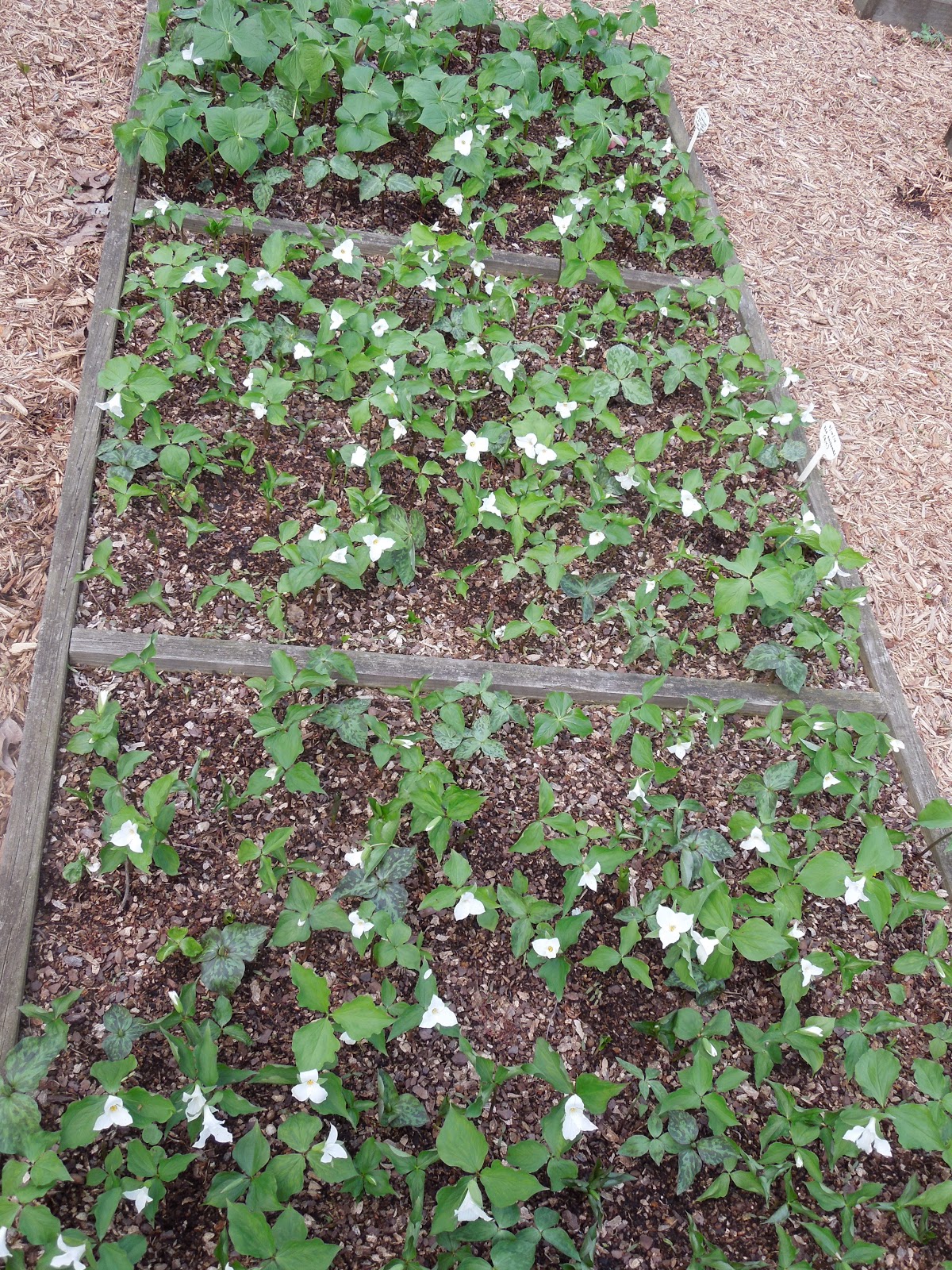
- Trillium - several species T. erectum, T. sessile, and T. grandiflorum - True ephemerals
- Hepatica nobilis - two kinds - round lobes (var. obtusa) and pointed lobes (var. acuta) - not a true ephemeral, since the foliage actually persists year-round, until the new foliage emerges in spring.
- Eastern Red Columbine Aquilegia canadensis - not an ephemeral, and I also learned that they evolved to be pollinated by hummingbirds.
- Twin Leaf - Jeffersonia diphylla - Woodland shade species, not an ephemeral
- Blood Root - Sanguinaria canadensis - Woodland shade species, not an ephemeral
- Trout Lily - Erythonium americanum - True ephemeral (not pictured)
- Skunk Cabbage Symplocarpus foetidus - Not a true ephemeral since the foliage persists until summer. (not pictured) more here.
- Mayapple - Podophyllum peltatum - Not a true ephemeral, with an edible berry, but only when absolutely ripe. Poisonous otherwise. The foliage persists until the fruit ripens; it may senesce earlier if the summer is hot and dry. (not pictured)
- Fringed Polygala, or Bird on the Wing - Polygala paucifolia - not a true ephemeral, and a one I had not heard of before (not pictured.) - foliage persists.
 |
| Fred Peabody |
Here are some pictures of other folks who were there.
Fred Peabody of the Cumberland Valley Woodland Owners kicked off the program.
 |
| MG's Judy Scriptunas, Linda Secrist, and Jane Krumpe |
Franklin County Master Gardeners, besides myself, who attended included Judy Scriptunas, Linda Secrist, and Jane Krumpe.
 |
| MG Juanita Kauffman and Husband Kenny |
 |
Penn State Extension Environmental Educator
George Hurd |
MG Juanita Kauffman and her husband Kenny were there, as well as MG's Georgia Townsend, and Steve Gray (not pictured.)
The program was organized by Penn State Extension Environmental Educator,
George Hurd.
 |
| Variegated Trillium? |
This final picture came from the Facebook feed of
Barry Glick, of
Sunshine Farms and Gardens earlier this week. While absolutely stunning, it turns out that these Trilliums are infected with
mycoplasma bacteria, which will eventually cause the plant to no longer flower, so they must be quarantined from other trilliums to prevent the spread of the disease.
Previous blog posts about my then understanding of Spring Ephemerals can be found
here and
here.
Update: Wednesday, May 1, 2013. Shoulda taken better notes. I had Annette review, and she caught some errors - all in the area of whether or not the plant qualifies as a true ephemeral. Corrections made. Won't tell you what they are to avoid further embarrassment.


.jpg)