Showing posts with label Mosquitoes. Show all posts

Sunday, September 16, 2012

Targeting West Nile

Intrepid reporter from the local newspaper The Public Opinion, Jim Hook, videotaped the Franklin County West Nile team during the preparations for, and start of spray operations in Quincy Township on Wednesday, September 12th.

Thursday, August 30, 2012

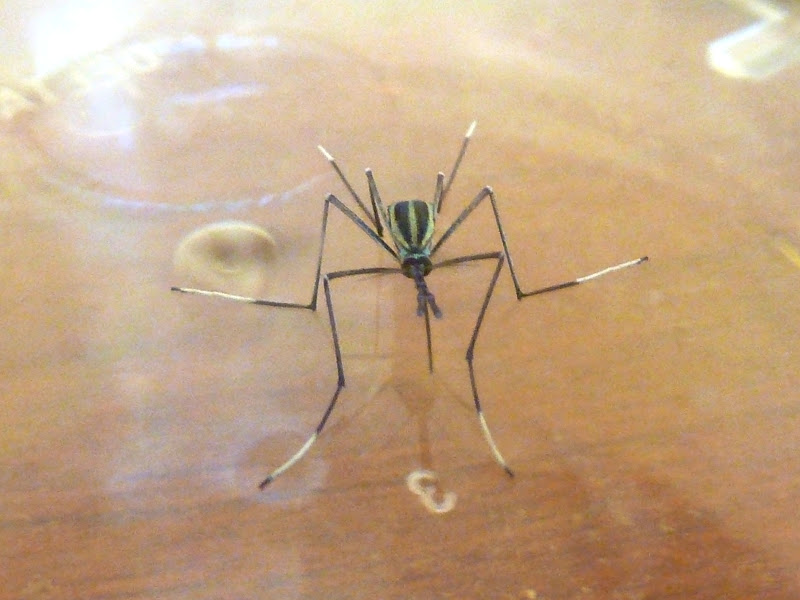
A Beneficial Mosquito?

Toxorhynchites rutilus septentrionalis
Yes there is such a thing.  Mosquitos in the genus Toxorhynchites are carnivores in their larval stage, eating other mosquito larvae.  They get enough protein in the larval stage that they do not need a blood meal as an adult, so only sip nectar as a food source.

Jason Goetz, the Franklin County West Nile seasonal technician this summer, caught one while dipping in a tire a few weeks back and we've been rearing it out.

She emerged this morning.  Jenn Wetzel has been taking periodic pictures, offered here.


Toxorhynchites rutilus septentrionalis - larva
According to Mike Hutchinson, the Pennsylvania Department of Environmental Protection entomologist for the West Nile program:
One larva can eat up to 400 mosquito larvae during its development. Larvae engage in cannibalism as well as compulsive killing. Fourth instar larvae in an advanced stage of development stop feeding, but continue killing other larvae in the container, especially conspecifics [other members of the same species - ed.]. They have been observed grasping a larva and scraping it across needle-like spines on the posterior margin of the saddle, ripping the larva in half.
Yikes!  We did watch her eating a larva that we fed to her, but we did not observe that barbaric killing spree.

Toxorhynchites rutilus septentrionalis pupae
The most obvious difference about them is their size, easily 5 times the size of the average mosquito. 

Toxorhynchites rutilus septentrionalis
They have been tried as a biological control agent, especially in tire piles, but success depends on an expensive, and labor intensive rearing and release program, since their natural numbers would not sufficiently manage an outbreak.

Toxorhynchites rutilus septentrionalis
Maybe it's just parental pride, but I think she's just beautiful.

Tuesday, June 19, 2012

Skeeter Stuff - 2012

My Seasonal Technician, Jason Goetz, worked with Jim Hook of the Public Opinion for a few hours last week visiting sites to conduct mosquito surveillance - dipping for larvae, and setting traps to collect adult mosquitoes.  They visited a manure lagoon at a dairy farm, a natural swampy area, and a site with used tires.  Here's the result:


The news article appeared in today's paper and can be read here.

To read about how to protect yourself from mosquitoes, ticks, and other biting critters, visit the Penn State PestEd blog (accessible from the Blog List to the Right), where I recently wrote about repellents here and here.

To learn more about the Integrated Mosquito Managment program here in Franklin County, come to the Penn State Extension Open House tomorrow, Wednesday, June 20th from 3:30-6:30. Learn all that Penn State Extension does for Franklin County folks.

Monday, August 10, 2009

BumbleBee, Monarch, and Dragon Fly

Some more great pictures from Laurie C., taken from her property. If you click on the picture, it will expand to full size, with incredible detail.


Bumble Bee rolling in pollen from a Rose of Sharon flower.


A newly emerged Monarch Butterfly. Note the wrinkles in the wings, still needing to be pumped up with blood and dried.


Dragonfly laying eggs in Laurie's pond. Insects in the order Odonata (Dragonflies and Damselflies) are considered beneficial since they are predators of mosquitoes and gnats. Dragon fly nymphs (called naiads) are also predaceous and will eat mosquito larvae, as well as other aquatic life.

Weird fact I just learned: Dragonfly naiad gills are located internally, within the rectum, where bellows-like contractions of the rectal muscles cause oxygenated water to circulate in and out.

See if you can identify the species. Here is a place to start using Discover Life. Here's a place to start using Bugwood. Home pages for both sites are available from the side bar.

Friday, August 7, 2009

Dr. Seuss and The Malaria Mosquito


I came across this while researching something else. During WWII, the military hired Dr. Seuss to come up with an information booklet to promote good practices amongst our soldiers to prevent malaria.